Too Long Didnt Read (TLDR)
Brief summary of the Tesamorelin + Ipamorelin peptide blend.
People search the tesamorelin + ipamorelin blend mostly for body-composition and growth-hormone research interest, especially fat-loss and recovery discussion in the research-use community.
It combines tesamorelin, a GHRH analog, with ipamorelin, a ghrelin-mimetic growth hormone secretagogue, so the two raise growth hormone through two different receptors.
Tesamorelin has FDA approval and Phase 3 human trial data in HIV-associated lipodystrophy; ipamorelin is mostly preclinical, with one human Phase 2 trial that was discontinued for lack of efficacy.
No published human trial has tested the blend itself, so its combined effect and safety profile are not established; it is not FDA-approved as a combination.
I verified the FDA status directly: tesamorelin's EGRIFTA WR formulation was FDA-approved on March 25, 2025, and I confirmed ipamorelin's discontinued ileus trial in the Beck et al. 2014 paper.
Definition
What it is
The tesamorelin + ipamorelin blend is an informal research-use combination of two peptides that both raise growth hormone (GH). It is not a standardized medical product. Suppliers sell it as a single pre-mixed vial, and it also goes by names like "tesamorelin/ipamorelin," "tes + ipa," and "tesamorelin and ipamorelin blend."
People search for it because each compound is linked to growth hormone and body composition, and combining them is a popular research-community idea. Before any mechanism talk, the simple version is this: one compound tells the body to make more GH, and the other pushes the same GH release through a second door.
Mechanism
How it works
Each compound contributes one half of a two-pathway idea. Tesamorelin is supposed to act like GHRH, the natural signal that tells the pituitary gland to release GH. Ipamorelin is supposed to act like ghrelin, a separate signal that also triggers GH release.
In receptor terms, tesamorelin binds GHRH receptors, while ipamorelin binds the growth hormone secretagogue receptor (GHS-R1a), the same receptor ghrelin uses. Because the two hit different receptors, the research logic is that together they produce a larger GH pulse than either alone.
This synergy is documented for the GHRH-plus-secretagogue drug classes in general, in human GH secretagogue studies. It has not been demonstrated for this specific blend in a human trial, so treat the combined effect as extrapolated, not proven.
- Tesamorelin: GHRH-receptor pathway
- Ipamorelin: GHS-R1a (ghrelin) pathway
- Main limitation: class-level synergy, not blend-level proof
Research use
What the research community uses it for
In real-world research-use discussion, the blend shows up around body-composition goals: fat loss (especially abdominal fat), lean-mass preservation, recovery, sleep quality, and general growth-hormone interest. This reflects how gym-goers, forums, and the supplier market talk about it, not a list of proven outcomes.
It is important to separate popularity from proof. Tesamorelin's fat-related interest traces back to real human trials in a specific HIV-associated condition, while ipamorelin's reputation rests largely on animal data. The blend's reputation borrows from both compounds. None of this is dosing, cycle, or personal-use guidance.
- Abdominal/visceral fat-loss research interest (driven by tesamorelin)
- Lean-mass preservation and recovery discussion
- General growth-hormone and sleep-quality interest
- Weaker-evidence: most blend-specific claims rely on extrapolation, not trials
Evidence
What the research shows
Direct stack evidence is the headline gap: no published human trial has tested the tesamorelin + ipamorelin blend as one product. Everything known comes from each compound on its own.
Tesamorelin is the stronger half. Phase 3 randomized, placebo-controlled trials in adults with HIV-associated lipodystrophy showed reduced visceral fat at 2 mg daily, which led to FDA approval. Ipamorelin is the weaker half for human evidence: the foundational Raun et al. 1998 work showed selective GH release in animals without raising cortisol, but its only human trial (a Phase 2 study in postoperative ileus) was discontinued for lack of efficacy.
The main unanswered questions are whether the two compounds add up as hoped in humans, what the combined safety profile looks like over time, and whether benefits seen in a specific clinical population generalize to healthy research interest. None of these has a blend-specific human answer.
Context
How it compares
The closest relatives are other GHRH-plus-secretagogue pairings. Sermorelin + ipamorelin swaps in sermorelin, an older, shorter-acting GHRH analog that is generally considered less potent and less stable than tesamorelin. CJC-1295 + ipamorelin swaps in CJC-1295, a longer-acting GHRH analog that extends the GHRH signal.
Compared with these, the tesamorelin pairing carries the strongest human-trial pedigree on the GHRH side, because tesamorelin is the only one of the three with FDA approval. That does not make the blends interchangeable — each GHRH partner behaves differently. For dosing-focused planning on any of these, Peptide Dosing Protocols is the protocol resource, not this page.
Boundaries
Safety and regulatory status
Observed adverse events come from the single compounds. Tesamorelin trials reported injection-site reactions, joint pain, fluid retention, muscle aches, and a signal for glucose intolerance and higher type 2 diabetes risk; it is contraindicated in pregnancy. Ipamorelin was generally well tolerated in limited data, with occasional flushing or headache, but its long-term human safety is not established.
Theoretical and unknown risks specific to the blend include the combined effect of raising GH through two pathways at once, and the lack of any human data on how the two interact over a full cycle. As of May 2026, tesamorelin is FDA-approved only for HIV-associated lipodystrophy (sold as EGRIFTA WR and EGRIFTA SV), ipamorelin is not FDA-approved, and the blend is not FDA-approved. It is sold for research use only.
Next
What to review next
To go deeper on each half, review the individual Tesamorelin and Ipamorelin guides, which cover mechanism and evidence in more detail. To compare GHRH partners, look at the sermorelin and CJC-1295 pairings rather than assuming they behave the same.
If your question is about dosing, reconstitution, or supplies, those belong on Peptide Dosing Protocols, the protocol-focused resource, rather than here. This guide stays on what the blend is and what the evidence supports.
Sourcing
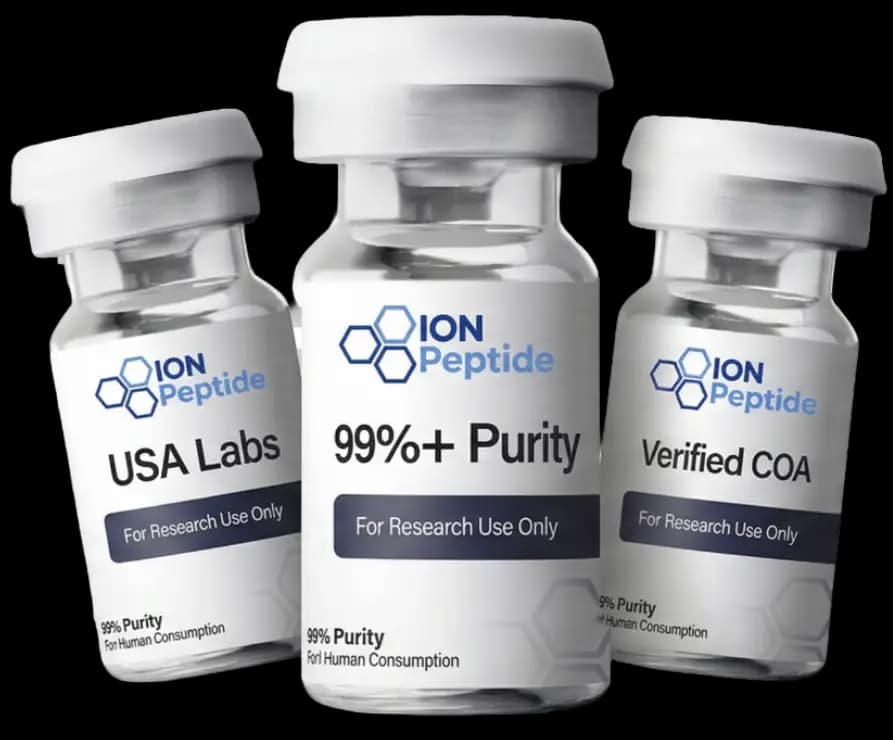
Tesamorelin + Ipamorelin 10mg
Ion Peptide tesamorelin + ipamorelin supplier option for research review. Confirm format, testing, and current availability on the supplier page.
View Ion PeptideFAQ
Tesamorelin + Ipamorelin FAQs
Short answers for the reusable peptide blend detail template.
What does tesamorelin and ipamorelin do together?
They raise growth hormone through two different receptors. Tesamorelin acts like GHRH and ipamorelin acts like ghrelin, so the research idea is that combining them produces a larger growth hormone pulse than either one alone. This synergy is documented for the drug classes in general but has not been tested for this specific blend in a human trial.
Can you take tesamorelin and ipamorelin together?
They are commonly combined in research-use discussion because they target separate growth hormone pathways. However, no human study has evaluated the blend itself, so the combined safety and effect profile is unknown. This guide is educational and is not medical advice or a recommendation to combine them.
Why combine tesamorelin and ipamorelin?
The rationale is two-pathway stimulation: a GHRH analog plus a ghrelin-mimetic secretagogue. In growth hormone research, pairing those two classes has amplified GH release compared with either alone. The blend applies that logic, though the specific combination has not been validated in people.
Which is better, tesamorelin or ipamorelin?
They do different jobs, so neither is simply better. Tesamorelin has FDA approval and human Phase 3 data on its side, while ipamorelin is mostly supported by animal studies. In the blend, tesamorelin is the compound with stronger human evidence, and ipamorelin is the more experimental partner.
How does it compare to sermorelin or CJC-1295 with ipamorelin?
All three pair a GHRH-type compound with ipamorelin. Sermorelin is older and shorter-acting, CJC-1295 is longer-acting, and tesamorelin is the only one of the three with FDA approval. They are not interchangeable, and each GHRH partner behaves differently.
Is the tesamorelin ipamorelin blend FDA-approved?
No. As of May 2026, tesamorelin is FDA-approved only for HIV-associated lipodystrophy, ipamorelin is not FDA-approved, and the blend is not approved as a combination product. It is sold for research use only.
Where can I find dosing information?
Peptide Advisors does not publish dosing protocols. For dosing, reconstitution, and supplies planning, see the protocol-focused resource at Peptide Dosing Protocols, which covers the tesamorelin and ipamorelin blend in detail.
References
/ 11Tesamorelin + Ipamorelin sources & citations
Primary sourcesPrimary clinical literature and pharmacology references behind this peptide blend guide.
- 01
Tesamorelin, a growth hormone-releasing factor analog, in HIV patients with abdominal fat accumulation.
Falutz J, et al. · JAMA · 2010
Phase 3 RCT showing visceral fat reduction with tesamorelin; strongest human evidence in the blend.
- 02
Theratechnologies receives FDA approval for EGRIFTA WR (tesamorelin F8).
Theratechnologies Inc. · Theratechnologies / GlobeNewswire · 2025
Confirms current FDA status; EGRIFTA WR approved March 25, 2025, still HIV-lipodystrophy only.
- 03
EGRIFTA (tesamorelin for injection) prescribing information.
U.S. Food and Drug Administration · FDA Drugs@FDA · 2010
Primary label; defines approved indication and the 2 mg SC daily reference dose.
- 04
Tesamorelin: clinical and research information on drug-induced liver injury.
LiverTox (NIDDK) · NCBI Bookshelf · 2018
Concise regulatory and pharmacology summary of tesamorelin as a GHRH analog.
- 05
Tesamorelin: a growth hormone-releasing factor analogue for HIV-associated lipodystrophy.
Spooner LM, Olin JL. · Annals of Pharmacotherapy · 2012
Reviews tesamorelin mechanism and clinical use; supports the GHRH-analog description.
- 06
Ipamorelin, the first selective growth hormone secretagogue.
Raun K, Hansen BS, Johansen NL, et al. · European Journal of Endocrinology · 1998
Foundational ipamorelin paper; GH-selective release without ACTH/cortisol elevation in animals.
- 07
Proof-of-concept study of the ghrelin mimetic ipamorelin for postoperative ileus.
Beck DE, Sweeney WB, McCarter MD, et al. · International Journal of Colorectal Disease · 2014
Ipamorelin's only human trial; Phase 2 discontinued for lack of efficacy. I verified the discontinuation here directly.
- 08
The safety and efficacy of growth hormone secretagogues (GHRH + GHRP synergy).
Sinha DK, et al. · PMC (PMC5632578) · 2017
Supports the dual-pathway synergy rationale at the class level, not the blend specifically.
- 09
Ipamorelin induces longitudinal bone growth in rats.
Johansen PB, Nowak J, Skjaerbaek C, et al. · Growth Hormone & IGF Research · 1999
Representative preclinical ipamorelin study; illustrates animal-only evidence base.
- 10
GHRH (tesamorelin) effects on brain GABA in mild cognitive impairment and healthy aging.
Friedman SD, Baker LD, Borson S, et al. · JAMA Neurology · 2013
One of the few tesamorelin studies outside HIV; supports the narrow human evidence base.
- 11
Tesamorelin: a review of its use in the management of HIV-associated lipodystrophy.
Dhillon S. · Drugs · 2011
Comprehensive tesamorelin review; abdominal fat reduction and safety signals.
Medical Disclaimer
This article is provided for educational research purposes only and should not be treated as medical advice. Tesamorelin + Ipamorelin is not an FDA-approved protocol or recommendation. Peptide blends should be evaluated only with appropriate physician oversight. Do not begin any peptide protocol without speaking with a licensed healthcare provider, and remember that individual responses can vary significantly.
Written by

Garret Grant
Founder & Lead Researcher · B.S. Civil Engineering, UCLA
Garret personally researches, writes, and reviews every guide on Peptide Advisors. Each page is sourced from peer-reviewed clinical trials, systematic reviews, and regulatory filings — with every claim cited and the source hierarchy published openly.
Last reviewed