Too Long Didnt Read (TLDR)
Brief summary of BPC-157 peptide.
BPC-157 is most often explored in the research community for tendon, ligament, muscle, joint, and gut-injury repair models.
It is a synthetic 15-amino-acid peptide built from a fragment found in human stomach fluid.
The strongest summary is a July 2025 HSS Journal systematic review that screened 544 papers and included 36 studies, only one of which was human.
The evidence boundary is clear: BPC-157 remains mostly preclinical, is listed by the FDA as a Category 2 bulk drug substance, and has been WADA-banned in sport since 2022.
I cross-checked that regulatory status against the FDA Category 2 listing and the 2025 HSS Journal review directly.
Definition
What BPC-157 actually is
BPC-157 stands for Body Protection Compound 157. It is a synthetic chain of fifteen amino acids — a short protein fragment — that scientists copied from a larger protein found in human gastric juice. The first papers on it appeared in the 1990s out of a research group in Croatia, and it has gone by a few other names in the literature: bepecin, PL 14736, and gastric pentadecapeptide BPC 157.
It is not made from natural tissue. Labs build it one amino acid at a time using a method called solid-phase peptide synthesis, so the final product depends entirely on the manufacturer's process and quality control. This is the BPC-157 peptide guide that explains what the published science says — and where it stops.
Mechanism
How BPC-157 is studied to work
Across animal studies, BPC-157 is reported to speed up tissue repair. The headline mechanism is that it pushes blood vessels to grow into damaged tissue — researchers call this angiogenesis. Without good blood supply, injured tissues cannot heal well; BPC-157 appears to widen the supply lines.
The way it does this, in cell and rodent studies, is by switching on a receptor called VEGFR2. That receptor is the one that growth-factor signals normally bind to when the body wants to build new vessels. Once VEGFR2 is activated, a downstream chain (Akt → eNOS) tells vessel walls to make more nitric oxide, which dilates the vessels and improves blood flow. Other studies report that BPC-157 also calms the inflammation switch NF-κB and supports cell migration into wound sites.
Important caveat: nearly all of this mechanistic work is in rats, mice, or cell culture. We don't have controlled human studies that confirm the same pathways behave the same way at the same doses in people.
- VEGFR2 activation — drives new blood vessel formation in animal wound models
- Akt-eNOS pathway — increases nitric oxide and improves local blood flow
- NF-κB downregulation — may dampen excess inflammation in repair tissue
- Main limitation — almost all of the pathway data is preclinical, not human
Research use
What the research community uses BPC-157 for
BPC-157 is most often discussed for tissue repair, gut injury, tendons, ligaments, muscles, and joints. In plain English, the main interest is whether it changes how damaged tissue heals. Most of that evidence comes from animal studies, not large human trials.
Sports-medicine discussions usually focus on tendon, ligament, muscle, and joint recovery. Gut discussions focus on ulcers, fistulas, and inflamed gut tissue. Smaller research areas include nerve injury, spinal cord injury, and blood-flow studies.
- Tendon and ligament repair interest.
- Muscle, joint, and fracture-healing research.
- Gut ulcers, fistulas, and inflamed gut tissue.
- Blood-flow research, including new blood-vessel growth.
- Nerve, spinal cord, and brain-injury models.
Evidence
What the research actually shows
The strongest single source on BPC-157 is a July 2025 systematic review in HSS Journal (Vasireddi et al.). The team searched PubMed, Cochrane, and Embase from inception through June 2024 and screened 544 papers. After filtering, 36 studies met inclusion: 35 were preclinical (animal or cell culture) and only 1 was clinical — a retrospective case series of intra-articular (injected into a joint) BPC-157 for knee pain. I verified that ratio against the published abstract on PubMed before writing this section.
The animal evidence is wide. Rat studies have looked at Achilles tendon transection, ligament healing, fracture repair, traumatic brain injury, spinal cord compression, and gut ulceration, and many of them report faster recovery in BPC-157-treated animals versus controls. The most cited mechanistic paper (Hsieh et al., 2017, J Mol Med) is where the VEGFR2 finding comes from.
Human evidence is much thinner. A 2021 retrospective case series (Lee & Padgett) reported reduced knee pain after intra-articular injection. A 2024 pilot study by Lee, Walker and Ayadi looked at BPC-157 in interstitial cystitis. A 2025 pilot study by the same group tested 10 mg and 20 mg intravenous infusions in two adults and reported no adverse effects on cardiac, hepatic, renal, thyroid, or glucose markers in that very small sample. None of these are randomized controlled trials, and none have been replicated at scale. Until phase 2 or phase 3 RCTs publish, every popular claim about BPC-157 in people remains an extrapolation from rodents.
Context
How BPC-157 compares to nearby compounds
BPC-157 is most often discussed alongside TB-500 (a synthetic fragment of thymosin beta-4) as a soft-tissue research peptide. Both are studied for repair, both are unapproved by the FDA, and both are WADA-banned in sport. They are not interchangeable — different mechanism, different evidence base, and any comparison should be read as research context, not a recommendation to use either one.
Within FDA-approved space, no peptide drug currently fills the same role BPC-157 is studied for. The closest regulated comparator for tendon and joint repair is platelet-rich plasma (PRP) — that is a procedure rather than a peptide, and it has actual randomized human trials behind it for several indications.
Boundaries
Safety and regulatory status
Observed adverse events in animal studies are sparse, and the small human pilots published so far reported good tolerability. That is not the same as a clean safety record. The HSS Journal 2025 review is explicit: there is not enough human data to characterize a side-effect profile, and the unregulated grey-market manufacturing pathway introduces contamination and dosing-accuracy risk that has nothing to do with the molecule itself.
There is also a theoretical concern that gets repeated across the literature. Because BPC-157 promotes angiogenesis — new blood vessel growth — researchers have raised the question of whether it could in principle support tumor growth in someone with an undiagnosed cancer. This concern is theoretical, not demonstrated, but it is the most-cited reason for caution in published reviews.
Regulatory picture, as of May 2026: BPC-157 is not approved by the FDA for any indication. In 2023, the FDA placed it on the Category 2 bulk drug substance list, which means licensed compounding pharmacies (503A and 503B) cannot legally compound it. It is not a legal dietary supplement ingredient. The World Anti-Doping Agency has banned it under category S0 since 2022, so any tested athlete who uses it faces sanction. New Zealand and Australia have moved to control it as a prescription-only medicine even though it is not actually available by prescription.
Next
What to review next
If you want to read the most current synthesis yourself, the HSS Journal 2025 systematic review by Vasireddi and colleagues is the place to start — it is open access on PMC. The 2025 Pharmaceuticals review by Józwiak and colleagues (PMC11859134) is a longer literature-and-patent overview. For mechanism, the 2017 Hsieh et al. paper in Journal of Molecular Medicine is the single most-cited piece of work on the VEGFR2 pathway, and the 2020 Hsieh et al. paper in Scientific Reports details the Src–Cav-1–eNOS signaling.
For comparison context, see the TB-500 peptide guide and the About page, which explains the source-tier method and regulatory boundaries used across Peptide Advisors.
Sourcing
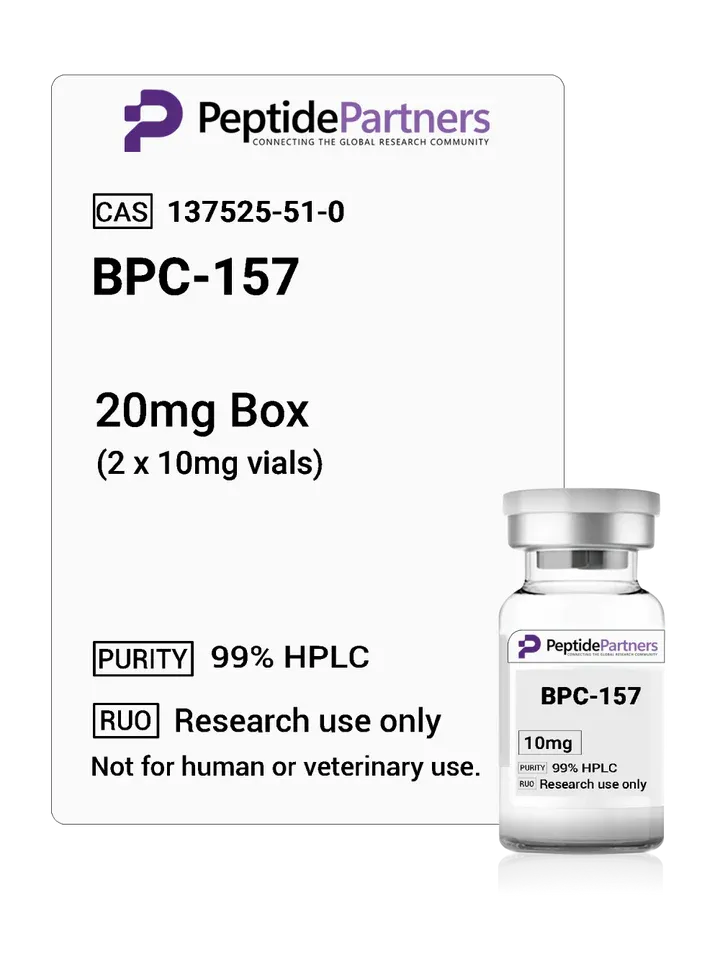
BPC-157 10mg
View a trusted research-use source for BPC-157 10mg.
Buy BPC-157View COAFAQ
BPC-157 FAQs
Short answers for the reusable peptide detail template.
What is BPC-157?
BPC-157, short for Body Protection Compound 157, is a synthetic 15-amino-acid peptide that researchers built based on a fragment found in human gastric juice. It is studied mostly in animals for tissue repair. It is not approved by the FDA for any medical use, and the World Anti-Doping Agency has banned it in sport since 2022. If you want the full evidence picture, see the evidence section above.
Is BPC-157 FDA-approved?
No. BPC-157 is not approved by the FDA for any condition. In 2023, the FDA placed it on the Category 2 bulk drug substance list, which means licensed compounding pharmacies cannot legally compound it. It is also not a legal dietary supplement ingredient. The published research is overwhelmingly preclinical — 35 of the 36 studies in the most recent systematic review were animal or cell-culture work.
Why is BPC-157 banned in sport?
The World Anti-Doping Agency added BPC-157 to its Prohibited List in 2022 under category S0, which covers substances that have not received regulatory approval for human use. It is banned both in and out of competition. WADA's reasoning is that an unapproved peptide with potential tissue-repair effects falls outside what is allowed, regardless of whether an athlete uses it for injury recovery. Athletes subject to WADA testing should treat any use as a sanction-level risk.
What does the human research on BPC-157 show?
Very little, and that is the honest answer. The 2025 systematic review in HSS Journal screened 544 papers and only one of the 36 included studies was clinical — a retrospective case series of intra-articular knee injections. A small 2025 pilot study tested 10 and 20 mg intravenous BPC-157 in two adults and reported no adverse signals. There are no published randomized controlled trials in people. Every popular benefit claim is currently an extrapolation from rodent work.
How does BPC-157 work in animal studies?
The most-cited mechanism is activation of a receptor called VEGFR2, which signals the body to grow new blood vessels into damaged tissue. Downstream of that, BPC-157 has been shown in rat and cell studies to increase nitric oxide via the Akt-eNOS pathway, which improves local blood flow, and to dampen the NF-κB inflammation switch. None of these pathway findings have been confirmed in controlled human trials at the same doses.
Is BPC-157 safe?
We do not have enough human data to make a confident safety statement. Animal studies and the small published human pilots have not shown serious adverse effects, but those samples are tiny and short. There is a theoretical concern, repeated across published reviews, that because BPC-157 promotes new blood vessel growth it could in principle support tumor growth — this is not proven, but it is the most-cited reason researchers urge caution. Quality also depends entirely on an unregulated supplier; contamination is a real and separate risk.
Why is BPC-157 sold as a research chemical?
Because there is no other legal path for it in the United States. The FDA has not approved BPC-157 as a drug, has placed it on the Category 2 bulk substance list so licensed compounding pharmacies cannot make it, and has not classified it as a legal dietary ingredient. Suppliers who sell it under a research-only label fall outside FDA-regulated drug channels. This guide is educational and does not endorse purchase or use outside an authorized clinical trial.
What is the difference between BPC-157 and TB-500?
Both are unapproved synthetic peptides studied for soft-tissue repair, but they are different molecules with different mechanisms. BPC-157 is a 15-amino-acid pentadecapeptide derived from a gastric protein fragment. TB-500 is a synthetic version of thymosin beta-4, a different signaling protein involved in cell migration and actin regulation. Both are WADA-banned and neither is FDA-approved. They are sometimes discussed together in the research literature, but they are not interchangeable.
References
/ 11BPC-157 sources & citations
Primary sourcesPrimary clinical literature and pharmacology references behind this guide.
- 01
Emerging Use of BPC-157 in Orthopaedic Sports Medicine: A Systematic Review
Vasireddi N, Hahamyan H, Salata MJ, Karns M, Calcei JG, Voos JE, Apostolakos JM · HSS Journal · 2025
Most current synthesis. Screened 544 papers, included 36: 35 preclinical and 1 clinical. The headline data point in this guide.
- 02
Multifunctionality and Possible Medical Application of the BPC 157 Peptide—Literature and Patent Review
Józwiak M, Bauer M, Kamysz W, Kleczkowska P · Pharmaceuticals (Basel) · 2025
Comprehensive 2025 literature and patent review. Useful for mechanism breadth and regulatory framing.
- 03
Therapeutic potential of pro-angiogenic BPC157 is associated with VEGFR2 activation and up-regulation
Hsieh MJ, Liu HT, Wang CN, Huang HY, Lin Y, Ko YS, et al. · Journal of Molecular Medicine · 2017
Primary mechanistic paper for the VEGFR2 angiogenesis pathway claim.
- 04
Modulatory effects of BPC 157 on vasomotor tone and the Src-Cav-1-eNOS signaling pathway in rats
Hsieh MJ, Lee CH, Chueh HY, Chang GJ, Huang HY, Lin Y, et al. · Scientific Reports · 2020
Source for the Akt-eNOS / nitric oxide pathway detail. Open access on PMC.
- 05
Pharmacokinetics, distribution, metabolism, and excretion of body-protective compound 157, a potential drug for treating various wounds, in rats and dogs
He L, Feng D, Guo H, Zhou Y, Li Z, Zhang K, et al. · Frontiers in Pharmacology · 2022
Source for half-life and pharmacokinetic statements. Half-life reported as under 30 minutes after IM or IV in animals.
- 06
Safety of Intravenous Infusion of BPC157 in Humans: A Pilot Study
Lee E, Walker C, Ayadi B · Alternative Therapies in Health and Medicine · 2025
Two-person human pilot of 10 mg and 20 mg IV BPC-157. Reported no adverse signals on standard biomarkers — sample size too small to generalize.
- 07
Intra-Articular Injection of BPC 157 for Multiple Types of Knee Pain
Lee E, Padgett B · Alternative Therapies in Health and Medicine · 2021
Retrospective case series — the single clinical study counted in the 2025 HSS Journal systematic review.
- 08
Regeneration or Risk? A Narrative Review of BPC-157 for Musculoskeletal Healing
McGuire FP, Martinez R, Lenz A, Skinner L, Cushman DM · Current Reviews in Musculoskeletal Medicine · 2025
Independent 2025 narrative review. Useful for cross-checking the mostly-preclinical evidence framing.
- 09
World Anti-Doping Code International Standard Prohibited List 2025
World Anti-Doping Agency · WADA · 2025
Confirms current S0 (non-approved substances) banned status. WADA first listed BPC-157 in 2022.
- 10
Notice of interim decisions to amend (or not amend) the current Poisons Standard
Therapeutic Goods Administration (Australia) · TGA · 2024
Australia regulatory background — supports the 'controlled as prescription-only in some jurisdictions' claim.
- 11
BPC-157
Wikipedia contributors · Wikipedia · 2026
General reference — used as a citation index to confirm primary sources, not as a primary source itself.
Medical Disclaimer
This article is provided for educational research purposes only and should not be treated as medical advice. BPC-157 is not FDA-approved. Compounded versions should be used only with appropriate physician oversight. Do not begin any peptide protocol without speaking with a licensed healthcare provider, and remember that individual responses can vary significantly.
Written by

Garret Grant
Founder & Lead Researcher · B.S. Civil Engineering, UCLA
Garret personally researches, writes, and reviews every guide on Peptide Advisors. Each page is sourced from peer-reviewed clinical trials, systematic reviews, and regulatory filings — with every claim cited and the source hierarchy published openly.
Last reviewed