Too Long Didnt Read (TLDR)
Brief summary of CJC-1295 peptide.
CJC-1295 is a synthetic peptide that researchers study because it makes the body release more of its own growth hormone.
It is a long-acting modified version of GHRH (growth hormone-releasing hormone), the natural signal the brain sends to the pituitary gland.
The strongest human evidence is a 2006 Phase 1 randomized controlled trial in healthy adults that reported a 5.8 to 8.1 day half-life and a 2-fold to 10-fold increase in growth hormone levels lasting six days or more after a single injection.
CJC-1295 is not FDA-approved, is prohibited by WADA, and Phase 2 development was halted in 2006 after a trial subject died (the attending physician judged the death unrelated to the drug).
I checked the Teichman 2006 trial data directly against the JCEM abstract and the Wikipedia clinical history before writing this section.
Definition
What CJC-1295 is
This CJC-1295 peptide guide starts with the basics. CJC-1295 is a 30 amino acid synthetic peptide. It is a modified copy of the first 29 amino acids of natural growth hormone-releasing hormone (GHRH), with a small chemical tag added to the end. The tag is called a Drug Affinity Complex, or DAC. DAC binds the peptide to albumin (a protein in the blood), which lets it stay active for days instead of minutes.
The compound was developed by ConjuChem Biotechnologies in the early 2000s. It was investigated for growth hormone deficiency and HIV-associated lipodystrophy and reached Phase 2 clinical trials. Development was halted in 2006 after one trial subject died. The attending physician concluded the most likely cause was undiagnosed coronary artery disease and judged the death unrelated to CJC-1295, but research stopped as a precaution.
There is also a short-acting version called CJC-1295 without DAC (or Modified GRF 1-29, or Mod GRF 1-29). It uses the same four amino acid changes that protect the peptide from enzymatic breakdown but skips the DAC tag, so it lasts roughly 30 minutes instead of days. The DAC and no-DAC versions are different compounds with different uses, even though both are sold under the CJC-1295 name. As of May 2026, CJC-1295 is not approved by the FDA for any use and the FDA Pharmacy Compounding Advisory Committee voted on December 4, 2024 to recommend against including it on the 503A Bulks List.
Mechanism
How CJC-1295 works
CJC-1295 tells the pituitary gland to make and release more of your own growth hormone. It does this by mimicking GHRH, the natural signal your hypothalamus sends to the pituitary every few hours.
On a technical level, CJC-1295 binds the GHRH receptor on pituitary somatotroph cells, which triggers a cAMP-dependent release of stored growth hormone. Released growth hormone then signals the liver to produce IGF-1 (insulin-like growth factor 1), which mediates most of the downstream effects of growth hormone on tissue.
The DAC version stays bound to albumin in the blood for days, so a single injection keeps GHRH receptors active far longer than natural GHRH would. In the only published human RCT, a single injection raised growth hormone levels for six days or more and IGF-1 levels for nine to eleven days. With weekly dosing, IGF-1 levels stayed above baseline for up to 28 days.
- Target: GHRH receptor on pituitary somatotroph cells
- Downstream effect: increased growth hormone release, then increased IGF-1
- DAC version half-life: 5.8 to 8.1 days (Teichman 2006)
- No-DAC version half-life: roughly 30 minutes
- Evidence is limited to Phase 1 healthy-adult trials and one halted Phase 2 trial
Research use
What the research community uses CJC-1295 for
CJC-1295 is most often discussed for raising the body's own growth hormone signal. In plain English, it tells the pituitary gland, a small hormone gland under the brain, to release more growth hormone. In community research-use talk, it most often appears with ipamorelin and is tied to body-composition, sleep, and recovery interest.
Published research is narrower. Human studies tested CJC-1295 as a way to study GH and IGF-1, two growth-related blood markers. One WADA-funded study used it to look for signs of growth hormone use in athletes. None of this proves the CJC-1295 plus ipamorelin pairing works in people.
- Growth hormone signaling, usually measured with GH and IGF-1.
- CJC-1295 plus ipamorelin discussions in community research-use settings.
- Body-composition, sleep, and recovery interest, without RCT proof.
- Athlete testing research, including WADA-funded biomarker work.
Evidence
What the research shows
The strongest evidence on CJC-1295 is a single 2006 publication in the Journal of Clinical Endocrinology and Metabolism by Teichman and colleagues. It combines two randomized, placebo-controlled, double-blind Phase 1 trials in healthy adults aged 21 to 61. Across the two trials, a single subcutaneous injection of CJC-1295 produced a 2-fold to 10-fold increase in mean plasma growth hormone for six days or more, and a 1.5-fold to 3-fold increase in IGF-1 for nine to eleven days. The estimated half-life was 5.8 to 8.1 days. With weekly or biweekly dosing, IGF-1 stayed above baseline for up to 28 days. The authors reported no serious adverse reactions and described the compound as relatively well tolerated at 30 to 60 mcg/kg.
A 2006 follow-up by Ionescu and Frohman in the same journal confirmed that pulsatile GH secretion was preserved during continuous CJC-1295 stimulation. A 2009 study by Sackmann-Sala and colleagues in Growth Hormone & IGF Research used serum from 11 healthy young men one week after a single 60 to 90 mcg/kg injection to identify protein biomarkers of GH/IGF-1 activation. These three publications represent the entire human evidence base. No additional human trials of CJC-1295 have been published since 2006.
The Phase 2 lipodystrophy trial was discontinued in 2006 after one trial subject died. The attending physician's most likely explanation was asymptomatic coronary artery disease with plaque rupture and occlusion. The physician judged the death unrelated to CJC-1295. ConjuChem terminated the program as a precaution. There is no published preclinical or clinical work that establishes long-term safety, no head-to-head trial against sermorelin or tesamorelin, and no human RCT of the CJC-1295 + ipamorelin combination that dominates community use.
Context
How CJC-1295 compares to sermorelin and tesamorelin
CJC-1295, sermorelin, and tesamorelin are all GHRH analogs that activate the same receptor. They are not interchangeable. Sermorelin is the closest comparator structurally — CJC-1295 is built from sermorelin's 29 amino acid backbone with four substitutions and (in the DAC version) the albumin-binding tag. Sermorelin has a half-life of about 10 to 12 minutes and was FDA-approved in 1997 for pediatric growth hormone deficiency, then discontinued in 2008 for manufacturing reasons. Tesamorelin (brand name Egrifta) is FDA-approved for HIV-associated lipodystrophy and has a half-life of roughly 30 minutes. CJC-1295 with DAC has by far the longest half-life of the three at 5.8 to 8.1 days, but it is the only one of the three that is neither currently FDA-approved nor on the 503A Bulks List.
The most common community comparison is to ipamorelin, which is not a GHRH analog at all. Ipamorelin activates the ghrelin receptor (GHSR1a), a separate GH-release pathway, which is why the two are often paired. Pairing them combines two different upstream signals to the same pituitary cells. The combination has never been tested in a published human RCT.
Boundaries
Safety and regulatory status
Reported adverse events from the only published human RCT (Teichman 2006) were limited and the authors described the compound as well tolerated at doses of 30 to 60 mcg/kg. No serious adverse reactions were reported in either Phase 1 trial. Outside that trial, the most consequential safety event in the CJC-1295 record is the 2006 Phase 2 lipodystrophy trial subject death described above. The attending physician judged it unrelated to the drug, but the program was halted and not restarted.
Theoretical concerns based on the GH/IGF-1 mechanism include: GH-driven insulin resistance and blood sugar effects (relevant for anyone with diabetes or prediabetes), fluid retention and carpal tunnel-like symptoms from elevated IGF-1, and the general principle that compounds that elevate IGF-1 are contraindicated in active malignancy because IGF-1 supports cell proliferation. None of these have been quantified for CJC-1295 in a long-term human trial because no long-term human trial exists.
As of May 2026, CJC-1295 is not approved by the FDA for any use. It has been prohibited by the World Anti-Doping Agency under Section S2.2.4 of the Prohibited List since 2009 (growth hormone-releasing factors). The FDA placed CJC-1295 on Category 2 of the interim 503A Bulks List in September 2023. Nominators withdrew their nominations on September 20, 2024, and the FDA Pharmacy Compounding Advisory Committee voted on December 4, 2024 to recommend against including any CJC-1295 form (free base, acetate, DAC free base, DAC acetate, DAC trifluoroacetate) on the 503A Bulks List.
Next
What to review next
If you are evaluating CJC-1295 for research, the Teichman 2006 paper in JCEM is the primary source — there is no substitute and no later trial. The Wikipedia entry maintains the most current regulatory and clinical-history summary. For broader context on the GH peptide class, the Tesamorelin guide covers the currently FDA-approved GHRH analog.
For protocol-level dosing research, Peptide Advisors does not publish protocols. Protocol-focused research lives at Peptide Dosing Protocols. For the full site context, use the peptide guide library to compare CJC-1295 against other endocrine and metabolic peptide summaries.
Sourcing
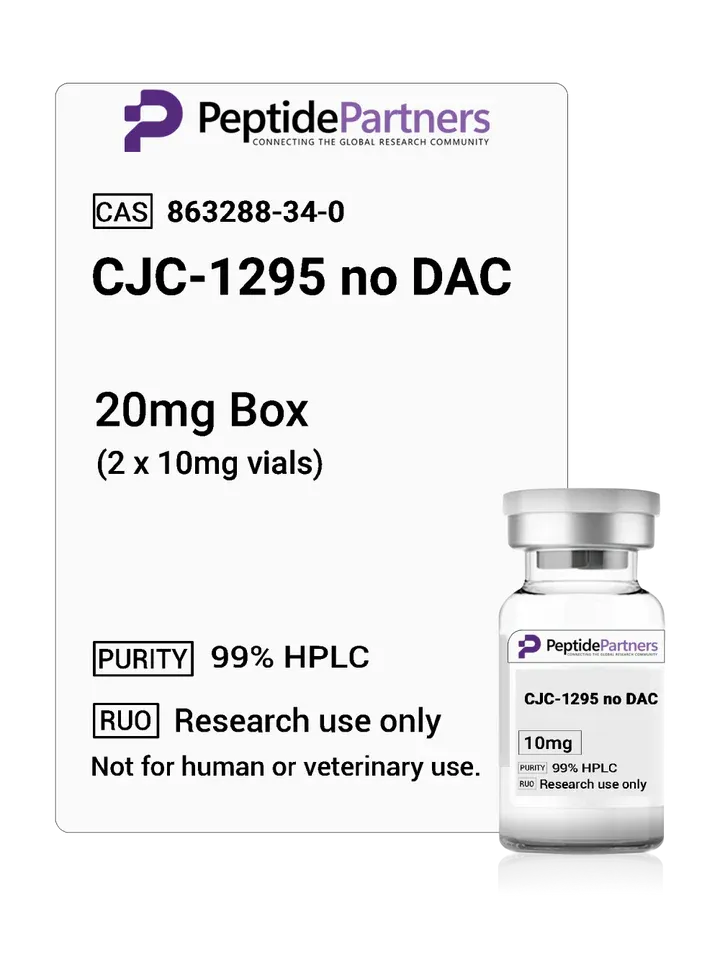
CJC-1295 Peptide
View a trusted research-use source for CJC-1295 peptide.
Buy CJC-1295View COAFAQ
CJC-1295 FAQs
Short answers for the reusable peptide detail template.
What is CJC-1295?
CJC-1295 is a synthetic 30 amino acid peptide that activates the GHRH receptor in the pituitary gland, which stimulates the body's own growth hormone release. It was developed by ConjuChem Biotechnologies in the early 2000s and reached Phase 2 trials before development was halted in 2006. As of May 2026 it is not FDA-approved for any use and is prohibited by WADA. There are two versions: CJC-1295 with DAC (long-acting, half-life 5.8 to 8.1 days) and CJC-1295 without DAC, also called Modified GRF 1-29 (short-acting, half-life around 30 minutes).
What is the difference between CJC-1295 with DAC and CJC-1295 without DAC?
DAC stands for Drug Affinity Complex. It is a chemical tag that binds the peptide to albumin in the blood, which extends its active life from minutes to days. CJC-1295 with DAC has a half-life of 5.8 to 8.1 days based on the Teichman 2006 trial. CJC-1295 without DAC, also called Modified GRF 1-29 or Mod GRF 1-29, has a half-life of roughly 30 minutes. They are different compounds with different pharmacokinetics, even though both are sold under the CJC-1295 name. The version studied in the only published human RCT is the DAC version.
Is CJC-1295 the same as ipamorelin?
No. They activate different receptors. CJC-1295 is a GHRH analog and binds the GHRH receptor. Ipamorelin is a growth hormone secretagogue that binds the ghrelin receptor (GHSR1a). They both raise growth hormone but through different upstream signals, which is why they are often paired in community research-use settings. The combination has never been tested in a published human randomized controlled trial.
Is CJC-1295 FDA-approved?
No. CJC-1295 is not FDA-approved for any indication as of May 2026. It reached Phase 2 trials for lipodystrophy and growth hormone deficiency before development was halted in 2006. The FDA placed it in Category 2 of the interim 503A Bulks List in September 2023. The Pharmacy Compounding Advisory Committee voted on December 4, 2024 to recommend against including any CJC-1295 form on the 503A Bulks List, which restricts its use in pharmacy compounding.
What does the CJC-1295 and ipamorelin combination do?
In published research, CJC-1295 alone activates the GHRH receptor on pituitary cells, and ipamorelin alone activates the ghrelin receptor on the same cells. Each independently raises growth hormone in studied populations. The combination is the dominant way CJC-1295 is discussed in community settings, with the stated rationale being that the two receptor pathways are additive. There is no published human randomized controlled trial of the combination, so combined efficacy and safety data are not available.
How long is CJC-1295's half-life?
In the Teichman 2006 trial in healthy adults, the estimated half-life of CJC-1295 with DAC was 5.8 to 8.1 days after subcutaneous injection. Growth hormone levels stayed elevated for six days or more after a single injection, and IGF-1 levels stayed elevated for nine to eleven days. With multiple weekly or biweekly doses, IGF-1 remained above baseline for up to 28 days. CJC-1295 without DAC has a much shorter half-life, roughly 30 minutes, because it lacks the albumin-binding tag.
Why was the CJC-1295 Phase 2 trial halted?
The Phase 2 lipodystrophy trial was halted in 2006 after one trial subject died. The attending physician concluded the most likely cause was asymptomatic coronary artery disease with plaque rupture, and judged the death unrelated to CJC-1295. ConjuChem terminated the development program as a precaution. No human trial of CJC-1295 has been published since 2006.
Does Peptide Advisors publish a CJC-1295 dosing protocol?
No. Peptide Advisors is an educational research summary site and does not publish dosing protocols. For protocol-focused research, Peptide Dosing Protocols is the appropriate reference. The only published human dosing data on CJC-1295 comes from the Teichman 2006 trial, which used 30 to 60 mcg/kg subcutaneous doses in healthy adults; this was a research trial protocol and is not a recommendation.
References
/ 10CJC-1295 sources & citations
Primary sourcesPrimary clinical literature and pharmacology references behind this guide.
- 01
Prolonged stimulation of growth hormone (GH) and insulin-like growth factor I secretion by CJC-1295, a long-acting analog of GH-releasing hormone, in healthy adults
Teichman SL, Neale A, Lawrence B, Gagnon C, Castaigne JP, Frohman LA · Journal of Clinical Endocrinology and Metabolism · 2006
The only published human RCT — two Phase 1 placebo-controlled trials in healthy adults aged 21-61. Single SC injection produced 2-10x GH increase for ≥6 days, 1.5-3x IGF-1 increase for 9-11 days, half-life 5.8-8.1 days. No serious adverse reactions at 30-60 mcg/kg.
- 02
Pulsatile secretion of growth hormone (GH) persists during continuous stimulation by CJC-1295, a long-acting GH-releasing hormone analog
Ionescu M, Frohman LA · Journal of Clinical Endocrinology and Metabolism · 2006
Confirmed that pulsatile GH secretion is preserved during continuous CJC-1295 stimulation. Counter-evidence to assumptions that long-acting GHRH analogs blunt the natural GH rhythm.
- 03
Activation of the GH/IGF-1 axis by CJC-1295, a long-acting GHRH analog, results in serum protein profile changes in normal adult subjects
Sackmann-Sala L, Ding J, Frohman LA, Kopchick JJ · Growth Hormone & IGF Research · 2009
WADA-supported proteomics study in 11 healthy young men, single SC dose 60-90 mcg/kg. Identified candidate biomarkers (ApoA1, transthyretin, hemoglobin beta, albumin fragments) of GH/IGF-1 activation. Confirms 8-10 day human half-life.
- 04
CJC-1295 (Wikipedia clinical history reference page)
Wikipedia contributors · Wikipedia · 2026
Maintained reference page summarizing CJC-1295 chemistry, pharmacokinetics, ConjuChem development history, and the 2006 Phase 2 lipodystrophy trial subject death and program termination. Cites Andersen-Hartvig 2014 and ConjuChem 2006 source.
- 05
Identification of peptide and protein doping related drug compounds confiscated in Denmark between 2007-2013
Hartvig RA, Holm NB, Dalsgaard PW, Reitzel LA, Müller IB, Linnet K · Scandinavian Journal of Forensic Science · 2014
Forensic source documenting CJC-1295's status as a confiscated grey-market peptide and noting program termination after the trial subject death. Used as the primary citation for the Phase 2 halt.
- 06
December 4, 2024 Meeting of the Pharmacy Compounding Advisory Committee — Briefing Document and Voting Questions
U.S. Food and Drug Administration · FDA Advisory Committee Materials · 2024
Official FDA voting questions for the PCAC meeting that recommended against including CJC-1295 (free base), CJC-1295 acetate, CJC-1295 DAC (free base), CJC-1295 DAC acetate, and CJC-1295 DAC trifluoroacetate on the 503A Bulks List.
- 07
FDA Briefing Document — Pharmacy Compounding Advisory Committee October 29, 2024 (peptide bulk drug substance review)
U.S. Food and Drug Administration · FDA Briefing Document · 2024
FDA's regulatory background on CJC-1295, ipamorelin, and related peptides. Documents the Category 2 designation history and the regulatory rationale for compounding restrictions.
- 08
FDA removes certain peptide bulk drug substances from Category 2 of interim 503A bulks list and sets dates for PCAC review
Lexology — law firm regulatory analysis · Lexology · 2024
Tier 3 regulatory analysis dating the September 20, 2024 nomination withdrawal that removed CJC-1295 from Category 2 and triggered the December 4, 2024 PCAC review.
- 09
WADA Prohibited List — Section S2.2.4 (Growth Hormone Releasing Factors)
World Anti-Doping Agency · WADA Prohibited List (2025) · 2025
Current WADA listing — CJC-1293, CJC-1295, sermorelin, and tesamorelin are all explicitly listed as prohibited GHRH analogs in S2.2.4, banned in- and out-of-competition.
- 10
Identification of CJC-1295, a growth-hormone-releasing peptide, in an unknown pharmaceutical preparation
Henninge J, Pepaj M, Hullstein I, Hemmersbach P · Drug Testing and Analysis · 2010
Documents grey-market CJC-1295 detection by Norwegian forensic authorities in 2009 — context for the gap between research-use and unregulated supply, and confirmation of S2 prohibited status.
Medical Disclaimer
This article is provided for educational research purposes only and should not be treated as medical advice. CJC-1295 is not FDA-approved. Compounded versions should be used only with appropriate physician oversight. Do not begin any peptide protocol without speaking with a licensed healthcare provider, and remember that individual responses can vary significantly.
Written by

Garret Grant
Founder & Lead Researcher · B.S. Civil Engineering, UCLA
Garret personally researches, writes, and reviews every guide on Peptide Advisors. Each page is sourced from peer-reviewed clinical trials, systematic reviews, and regulatory filings — with every claim cited and the source hierarchy published openly.
Last reviewed