Too Long Didnt Read (TLDR)
Brief summary of MOTS-c peptide.
MOTS-c peptide is studied mainly for metabolism, exercise capacity, and aging.
It is a 16-amino-acid peptide encoded inside mitochondrial DNA, first described by USC researchers in 2015.
The strongest evidence comes from mouse studies showing better glucose handling, fat oxidation, and treadmill performance, plus human observational data showing that exercise raises the body's own MOTS-c levels.
No published Phase 2 or Phase 3 trial has tested MOTS-c for any human disease, and the only human safety data is from a short Phase 1 study of an analog.
I checked the 2015 Cell Metabolism paper and the 2021 Nature Communications paper directly to confirm those evidence boundaries.
Definition
What it is
MOTS-c peptide is a 16-amino-acid signaling peptide your own mitochondria make. The acronym stands for Mitochondrial Open Reading Frame of the 12S rRNA Type-c. The amino acid sequence is MRWQEMGYIFYPRKLR.
Most peptides are encoded by DNA in the cell nucleus. MOTS-c is unusual because it is encoded inside mitochondrial DNA itself. That makes it part of a small group of mitochondrial-derived peptides (MDPs) that also includes Humanin and the SHLP family.
Researchers at the University of Southern California first reported MOTS-c in a 2015 Cell Metabolism paper. As of May 2026, it is not approved by the FDA for any medical condition. The World Anti-Doping Agency added MOTS-c to the prohibited list under section S4.4 (Hormone and Metabolic Modulators) starting with the 2024 list.
Mechanism
How it works
In plain terms: MOTS-c tells cells to burn more glucose and fat and to use energy more efficiently.
On the molecular side, mouse and cell studies show MOTS-c activates AMP-activated protein kinase (AMPK), an enzyme that acts as a cellular energy sensor. AMPK activation increases glucose uptake, raises fat oxidation, and pushes the cell toward energy production rather than energy storage. A 2018 Cell Metabolism paper added that under metabolic stress, MOTS-c moves into the cell nucleus and changes how stress-response genes are expressed.
Most of this mechanism work was done in mice and isolated cells. Human evidence is limited to observational data — circulating MOTS-c rises with exercise and falls with age — not interventional human trials.
- Activates AMPK, the cellular energy sensor
- Increases glucose uptake and fat oxidation in muscle
- Translocates to the nucleus under metabolic stress to alter gene expression
- Mechanism almost entirely characterized in mouse and cell models
Research use
What the research community uses MOTS-c for
MOTS-c is most often discussed for metabolism, exercise capacity, and aging research. Metabolism means how the body uses fuel, especially sugar and fat. The main interest is whether MOTS-c can change energy use inside muscle and other tissues.
The evidence is still early. Most findings come from mice, cell studies, and human studies that only measure the body's own MOTS-c levels. That means MOTS-c is interesting for energy and aging research, but it has not been proven as a human treatment.
- Metabolism interest, including sugar handling and fat use.
- Exercise interest, mostly treadmill and endurance studies in mice.
- Aging interest, including lower natural MOTS-c levels with age.
- Bone, immune, and heart signaling, mostly early animal research.
- CB4211, a related analog, has short Phase 1 safety data.
Evidence
What the research shows
The foundational paper is Lee et al. 2015 in Cell Metabolism. In mice, MOTS-c treatment prevented diet-induced obesity and reversed both age-related and high-fat-diet-induced insulin resistance. The proposed mechanism was AMPK activation through the folate-AICAR pathway. The paper also showed that MOTS-c is expressed in many human tissues and circulates in plasma. This was a mouse and cell study, not a human treatment study.
The most-cited follow-up is Reynolds et al. 2021 in Nature Communications. In mice, intermittent MOTS-c (3 times per week, starting at 23.5 months of age — roughly the human equivalent of late middle age) improved treadmill running time and total distance. In humans, the same paper showed exercise raises endogenous MOTS-c expression in skeletal muscle and circulation. The mouse arm was an interventional study. The human arm was observational only.
Direct human interventional data is much thinner. Dieli-Conwright et al. 2021 (Scientific Reports) tested a 16-week aerobic and resistance exercise program in breast cancer survivors and reported that post-exercise MOTS-c levels rose in non-Hispanic White participants and correlated with reductions in fat mass and HOMA-IR. This is exercise-induced endogenous MOTS-c, not exogenous MOTS-c administration. According to the Alzheimer's Drug Discovery Foundation summary, the only published human administration data comes from a short-term Phase 1 trial of CB4211, a MOTS-c analog, where the analog was generally tolerated but persistent injection-site reactions were common.
I verified those primary findings in the 2015 Cell Metabolism paper and the 2021 Nature Communications paper directly. Limitations to flag: no Phase 2 or Phase 3 efficacy trial has been published for MOTS-c in any human condition. Long-term human safety data does not exist. Most claims you will see online about MOTS-c benefits in humans are extrapolated from mouse data.
Context
How it compares to similar peptides
MOTS-c sits in the mitochondrial-derived peptide (MDP) family, which is small and unusual.
Humanin was the first MDP described and is studied mainly for cytoprotection and neurological signaling rather than metabolism. SS-31 (elamipretide) is a synthetic mitochondria-targeting peptide that works by stabilizing cardiolipin in the inner mitochondrial membrane — a different mechanism from MOTS-c's AMPK activation. SS-31 also has further-developed human trial data than MOTS-c does.
These compounds are not interchangeable. They share a mitochondrial theme but act on different targets and have very different evidence bases. Treat any "mitochondrial peptide" comparison as a category label, not a class equivalence.
Boundaries
Safety and regulatory status
Observed safety data in humans is extremely limited. The only published human dosing study is a short-term Phase 1 trial of the analog CB4211, which was generally tolerated but produced persistent injection-site reactions in many participants. No long-term human safety data on MOTS-c itself has been published.
Theoretical concerns flagged in the literature include hypoglycemia in people on insulin or sulfonylurea medications (because of enhanced glucose uptake), and unknown effects on cell growth pathways. These are theoretical from mouse and mechanism work, not observed adverse-event rates from human RCTs — because no such RCTs exist.
As of May 2026, MOTS-c is not approved by the FDA for any medical use. It is sold as research-use-only material by chemistry and peptide suppliers. The World Anti-Doping Agency added MOTS-c to the Prohibited List under section S4.4 (Hormone and Metabolic Modulators) for the 2024 list and it remains banned at all times for athletes subject to anti-doping testing.
Next
What to review next
If you want to read the primary sources directly, start with Lee et al. 2015 (Cell Metabolism, PMC4350682) for the discovery paper and Reynolds et al. 2021 (Nature Communications, PMC7817689) for the exercise and aging mouse + human-observational data.
For comparison reading inside Peptide Advisors, review the Retatrutide guide, the Cagrilintide guide, and the Tesamorelin guide. They cover different metabolic or endocrine research questions, which helps separate MOTS-c's mitochondrial framing from incretin and GHRH-analog evidence. For a different longevity-research angle, compare the Epitalon guide, which focuses on telomeres and circadian markers rather than mitochondrial signaling.
For protocol-style research questions about dosing schedules, reconstitution math, or vial sizing, Peptide Advisors does not publish protocols. Review Peptide Dosing Protocols instead.
Sourcing
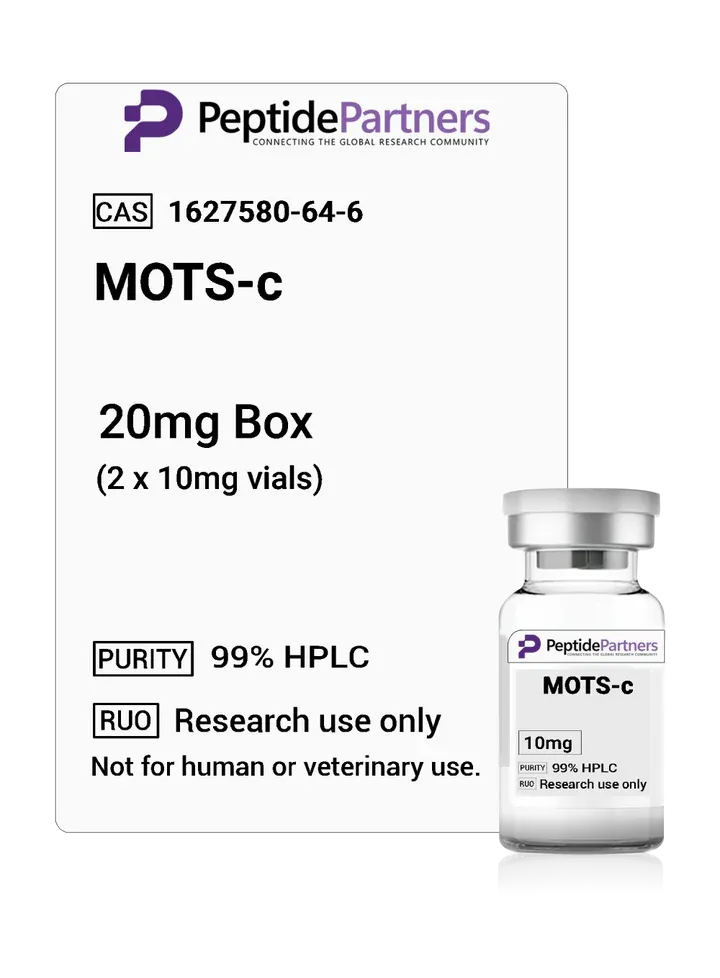
MOTS-c Peptide
View a trusted research-use source for MOTS-c peptide.
Buy MOTS-cView COAFAQ
MOTS-c FAQs
Short answers for the reusable peptide detail template.
What is MOTS-c peptide?
MOTS-c is a 16-amino-acid peptide encoded by mitochondrial DNA in the 12S rRNA region. It was first described in a 2015 Cell Metabolism paper from the University of Southern California. Researchers study it for its role in glucose metabolism, fat oxidation, and exercise-related signaling. As of May 2026, it is not FDA-approved for any condition.
What does MOTS-c peptide do in the body?
In mouse and cell studies, MOTS-c activates an enzyme called AMPK, which acts as a cellular energy sensor. AMPK activation increases glucose uptake and fat burning in muscle and shifts cells toward energy production rather than storage. MOTS-c also moves into the cell nucleus under metabolic stress and changes how some genes are expressed. Most of this evidence is preclinical.
What are the reported benefits of MOTS-c peptide?
In mice, MOTS-c treatment improved glucose handling, prevented diet-induced obesity, and increased treadmill running performance in young, middle-aged, and old animals. In human observational studies, exercise raises endogenous MOTS-c levels, and circulating MOTS-c declines with age. No published Phase 2 or Phase 3 trial has tested whether giving MOTS-c to humans produces these benefits in people.
How is MOTS-c peptide dosed?
Peptide Advisors does not publish dosing protocols. Published mouse studies used doses around 5–15 mg/kg, which do not translate directly to human dosing without trial data. The only published human MOTS-c-related dosing is a short Phase 1 safety study of the analog CB4211. For protocol-focused research, review Peptide Dosing Protocols.
Is MOTS-c peptide safe?
Long-term human safety data does not exist. The only published human dosing study used a MOTS-c analog (CB4211) and reported that it was generally tolerated short-term but produced persistent injection-site reactions in many participants. Theoretical concerns include low blood sugar in people on diabetes medications. Always consult a qualified healthcare provider before considering any peptide.
Is MOTS-c peptide FDA-approved?
No. As of May 2026, MOTS-c is not FDA-approved for any medical condition. It is sold as research-use-only material by peptide and chemistry suppliers. It is also banned by the World Anti-Doping Agency under section S4.4 (Hormone and Metabolic Modulators), with that ban explicitly listed starting with the 2024 Prohibited List.
Why is MOTS-c called an exercise mimetic?
MOTS-c activates many of the same metabolic pathways that exercise activates, especially AMPK. In humans, exercise raises endogenous MOTS-c expression in skeletal muscle and circulation. In mice, giving MOTS-c improves treadmill performance even without training. The label is a research-context shorthand, not a claim that MOTS-c replaces the broader benefits of physical activity.
Does MOTS-c decline with age?
Yes — based on observational human data, circulating MOTS-c levels are lower in older adults than in younger adults. Researchers have proposed that this age-related decline contributes to age-related metabolic decline, but that is a hypothesis derived from correlation. Whether restoring MOTS-c levels reverses any of those changes in humans has not been tested in a published trial.
References
/ 11MOTS-c sources & citations
Primary sourcesPrimary clinical literature and pharmacology references behind this guide.
- 01
The mitochondrial-derived peptide MOTS-c promotes metabolic homeostasis and reduces obesity and insulin resistance
Lee C, Zeng J, Drew BG, Sallam T, Martin-Montalvo A, Wan J, Kim SJ, Mehta H, Hevener AL, de Cabo R, Cohen P · Cell Metabolism · 2015
Foundational mouse study identifying MOTS-c, demonstrating AMPK activation and prevention of diet-induced obesity and insulin resistance.
- 02
MOTS-c is an exercise-induced mitochondrial-encoded regulator of age-dependent physical decline and muscle homeostasis
Reynolds JC, Lai RW, Woodhead JST, Joly JH, Mitchell CJ, Cameron-Smith D, Lu R, Cohen P, Graham NA, Benayoun BA, Merry TL, Lee C · Nature Communications · 2021
Mouse interventional study + human observational sampling showing improved physical capacity in old mice and exercise-induced MOTS-c expression in human skeletal muscle.
- 03
Effect of aerobic and resistance exercise on the mitochondrial peptide MOTS-c in Hispanic and Non-Hispanic White breast cancer survivors
Dieli-Conwright CM, Sami N, Norris MK, Wan J, Kumagai H, Kim SJ, Cohen P · Scientific Reports · 2021
16-week exercise intervention in breast cancer survivors; post-exercise MOTS-c rose in non-Hispanic White participants and correlated with metabolic improvements (NCT01140282).
- 04
Mitochondria-derived peptide MOTS-c: effects and mechanisms related to stress, metabolism and aging
Wan W, Zhang L, Lin Y, Rao X, Wang X, Hua F, Ying J · Journal of Translational Medicine · 2023
Comprehensive review of MOTS-c signaling across stress, metabolism, and aging contexts.
- 05
MOTS-c Functionally Prevents Metabolic Disorders
Gao Y, Wei X, Wei P, Lu H, Zhong L, Tan J, Liu H, Liu Z · Metabolites · 2023
Review summarizing MOTS-c effects on insulin resistance, obesity, muscle, bone, immune, and aging endpoints in preclinical models.
- 06
MOTS-c, the Most Recent Mitochondrial Derived Peptide in Human Aging and Age-Related Diseases
Mohtashami Z, Singh MK, Salimiaghdam N, Ozgul M, Kenney MC · International Journal of Molecular Sciences · 2022
Review of MOTS-c in human aging and age-related disease contexts; emphasizes preclinical-to-human translation gaps.
- 07
Mitochondrial-derived peptides: Antidiabetic functions and evolutionary perspectives
Kal S, Mahata S, Jati S, Mahata SK · Peptides · 2024
Review of mitochondrial-derived peptides including MOTS-c, with focus on glucose metabolism mechanisms.
- 08
MOTS-c: A promising mitochondrial-derived peptide for therapeutic exploitation
Mohtashami Z, Singh MK, Salimiaghdam N, Ozgul M, Kenney MC · Frontiers in Endocrinology / PMC · 2023
Review of MOTS-c mechanisms and therapeutic exploration; useful summary of nuclear translocation work.
- 09
Casein kinase 2 is a direct binding partner and a functional target of the exercise-mimetic microprotein MOTS-c
Kumagai H, Kim SJ, Miller B, Natsume T, Lee SH, Sato A, Ramirez R, Wan J, Mehta HH, Yen K, Cohen P · Physiology · 2023
Identifies casein kinase 2 (CK2) as a direct binding partner for MOTS-c, refining mechanism beyond AMPK alone.
- 10
MOTS-c (Cognitive Vitality summary)
Alzheimer's Drug Discovery Foundation · Cognitive Vitality / ADDF · 2024
Independent summary noting MOTS-c therapeutic safety has not been established and that the analog CB4211 was tolerated short-term but produced persistent injection-site reactions.
- 11
Explanation of Key Changes on the 2024 WADA Prohibited List (MOTS-c addition)
USADA · U.S. Anti-Doping Agency Athlete Advisory · 2023
Confirms WADA's explicit addition of MOTS-c to the Prohibited List under section S4.4 for 2024 onward.
Medical Disclaimer
This article is provided for educational research purposes only and should not be treated as medical advice. MOTS-c is not FDA-approved. Compounded versions should be used only with appropriate physician oversight. Do not begin any peptide protocol without speaking with a licensed healthcare provider, and remember that individual responses can vary significantly.
Written by

Garret Grant
Founder & Lead Researcher · B.S. Civil Engineering, UCLA
Garret personally researches, writes, and reviews every guide on Peptide Advisors. Each page is sourced from peer-reviewed clinical trials, systematic reviews, and regulatory filings — with every claim cited and the source hierarchy published openly.
Last reviewed