Too Long Didnt Read (TLDR)
Brief summary of the CJC-1295 + Ipamorelin peptide blend.
The CJC-1295 + Ipamorelin stack is the most-discussed growth hormone peptide combination in the research community, paired for pulsatile GH release rather than for any approved clinical use.
The page should explain the dual-pathway mechanism (CJC-1295 on GHRH receptors; Ipamorelin on the ghrelin receptor) and clarify why the no-DAC variant of CJC-1295 is the more common pairing partner.
It should separate research-community shorthand from proven human clinical evidence, since each compound has its own human data but the blend itself has no published human RCT at common planning doses.
Definition
What the CJC-1295 + Ipamorelin stack is
The CJC-1295 + Ipamorelin stack is an informal research-community pairing of two growth hormone secretagogues. Together they are the most widely discussed GH peptide combination online, often sold as a pre-blended 10 mg vial (5 mg CJC-1295 + 5 mg Ipamorelin) at a 1:1 ratio.
The stack is not an FDA-approved treatment, not a standardized clinical protocol, and not a single supplier's branded product. It is community shorthand for combining a GHRH analog (CJC-1295) with a selective ghrelin-receptor agonist (Ipamorelin) so the two compounds act on different receptor pathways at the same time. As of May 2026 both compounds are research-use-only.
Research use
What the research community uses CJC-1295 + Ipamorelin for
In the research-use peptide market, this stack is most commonly associated with growth-hormone-axis research: GH and IGF-1 elevation, body-composition research interest, post-exercise recovery research, and sleep-quality research interest. These are the practical intent clusters people search for, not formal academic-institution research programs.
Most of this interest sits on the popularity side rather than the proven-outcome side. Each compound has individual human pharmacokinetic data, but the blend at the daily 200-300 mcg planning doses common online has no published human RCT. Long-term safety beyond 90 days is also limited even for the individual compounds.
- Growth hormone and IGF-1 axis research interest.
- Body composition and recovery research discussions.
- Sleep depth and slow-wave-sleep research interest.
- Comparative interest against Sermorelin, MK-677, and older GHRP secretagogues.
Stack logic
Why CJC-1295 (no DAC) and Ipamorelin are discussed together
The two compounds hit completely different receptor systems on the same pituitary cells. CJC-1295 is a 30-amino-acid GHRH analog that binds GHRH receptors and signals the pituitary to make and prepare GH. Ipamorelin is a 5-amino-acid pentapeptide that binds the ghrelin receptor (GHSR1a) and triggers the actual GH release pulse. I checked the receptor-cross-talk claim against the Cunha and Mayo 2002 Endocrinology paper directly: it shows that active ghrelin-receptor signaling potentiates GHRH-induced cAMP production in cells expressing both receptors.
The no-DAC variant of CJC-1295 is the typical pairing partner because its 30-minute to 2-hour half-life matches Ipamorelin's roughly 2-hour half-life, which preserves a pulsatile pattern. The DAC variant has a 5.8 to 8.1 day half-life and produces sustained GHRH stimulation, which fits poorly with Ipamorelin's pulse-based mechanism.
Evidence
What the research actually shows
No published human randomized trial has tested CJC-1295 (no DAC) + Ipamorelin at the daily 200-300 mcg doses common in online research planning. The case for the stack rests on each compound's individual data plus shared-cell mechanism evidence.
For CJC-1295, the foundational human study is Teichman 2006 in the Journal of Clinical Endocrinology and Metabolism, which tested CJC-1295 with DAC in 24 healthy adults and showed dose-dependent 2 to 10-fold GH increases for 6 or more days and 1.5 to 3-fold IGF-1 increases for 9 to 11 days. I verified the half-life figure of 5.8 to 8.1 days in the JCEM abstract directly. That study evaluated the DAC variant, so its dose-duration findings do not translate directly to the no-DAC form most often paired with Ipamorelin.
For Ipamorelin, the foundational paper is Raun 1998 in the European Journal of Endocrinology, which established that Ipamorelin produces GH release without elevating ACTH or cortisol, even at 200 times the effective GH-releasing dose. Gobburu 1999 modeled the human pharmacokinetics, showing peak GH around 40 minutes post-dose and a half-life of roughly 1.5 to 2.5 hours.
Limitations are real: the blend has no published human RCT, no long-term safety data beyond 90 days, no published evidence for the non-DAC CJC-1295 form at the daily doses common online, and limited population diversity (most studies were healthy adults, often male).
Context
How it compares to nearby stacks and single peptides
Sermorelin is the original GHRH analog, FDA-approved in 1997 for pediatric GH deficiency and withdrawn in 2008 for manufacturing reasons rather than safety. It has the strongest human evidence base of any GHRH analog and is also paired with Ipamorelin in many clinic protocols. CJC-1295 is studied for its longer half-life and more practical dosing, not for stronger evidence.
MK-677 (Ibutamoren) is an oral ghrelin mimetic. It avoids injections but produces continuous GH elevation similar to CJC-1295 with DAC, which raises receptor-desensitization questions and does not fit the pulsatile rationale that Ipamorelin's selectivity is built around.
GHRP-2 and GHRP-6 are older ghrelin-receptor agonists more potent at raw GH stimulation than Ipamorelin. The trade-off is real: both raise cortisol, prolactin, and appetite. Ipamorelin's selectivity (no significant ACTH or cortisol rise per Raun 1998) is the reason it became the default GHRP for cleaner research planning. None of these compounds are interchangeable.
Boundaries
Safety and regulatory status
Observed effects from the individual compounds include transient facial flushing in the first 5 to 10 minutes after CJC-1295 injection, mild water retention in the first 1 to 2 weeks, vivid dreams or improved sleep depth, and a small post-injection appetite bump from Ipamorelin. The October 2024 FDA PCAC briefing on Ipamorelin specifically noted immunogenicity risk and limited clinical evidence.
Theoretical and outcome-related risks include carpal tunnel-style symptoms (signaling excessive GH or IGF-1), elevated fasting glucose because GH is counter-regulatory to insulin, persistent joint pain, and the well-established concern that GH and IGF-1 promote cell proliferation. Anyone with active or prior cancer, pituitary disease, diabetic retinopathy, severe kidney disease, or pregnancy should not use GH-stimulating peptides.
As of May 2026, neither compound is FDA-approved for any clinical use. Both were placed on FDA Category 2 of the interim 503A bulks list in September 2023, removed in September 2024 after withdrawn nominations, and reviewed by the Pharmacy Compounding Advisory Committee in October and December 2024. The FDA recommended against including either in the 503A Bulks Regulation. Public statements in February 2026 from HHS Secretary Robert F. Kennedy Jr. signaled intent to reclassify multiple peptides, but no formal FDA action has been published. Reclassification timing is uncertain.
Next
What to review next
For dosing and reconstitution context, Peptide Advisors does not publish dosing protocols. Researchers wanting protocol-focused planning should review Peptide Dosing Protocols.
For the individual compound research summaries on Peptide Advisors, see the CJC-1295 (no DAC) and Ipamorelin guide pages. For broader regulatory and supplier context, primary sources are the FDA's 503A Bulks List page and the PCAC briefing documents from October and December 2024. The strongest single human paper to read for CJC-1295 is Teichman 2006 in JCEM; for Ipamorelin, Raun 1998 in the European Journal of Endocrinology.
Sourcing
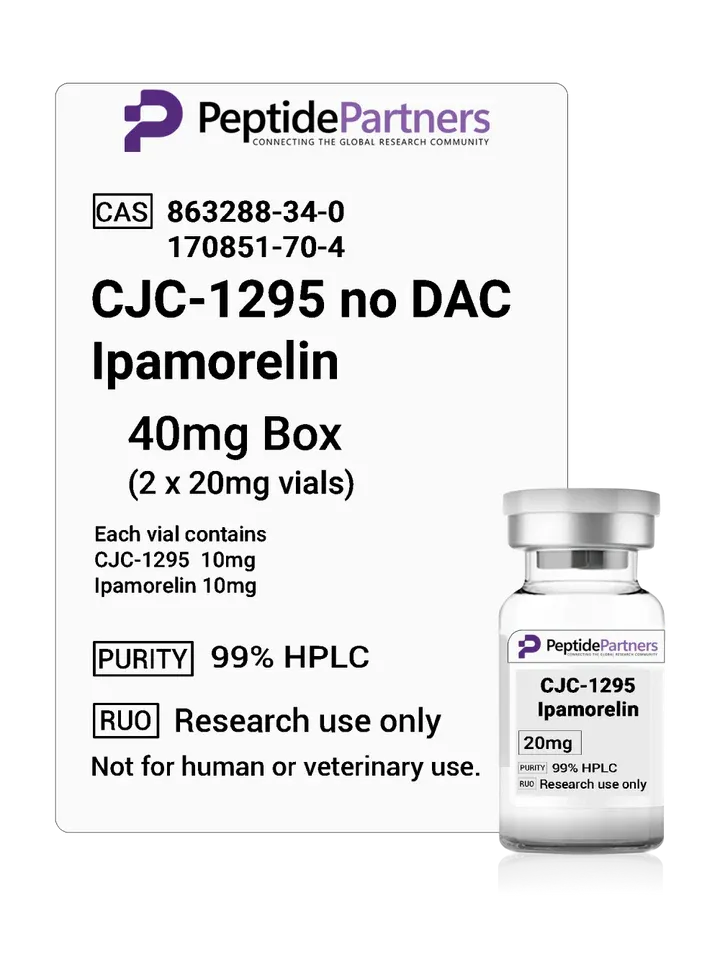
CJC-1295 + Ipamorelin Blend
Research-use sourcing context for the common CJC-1295 (no DAC) + Ipamorelin blend. No dosing, treatment, or human-use claim is implied.
View CJC-1295 + Ipamorelin blendView COAFAQ
CJC-1295 + Ipamorelin FAQs
Short answers for the reusable peptide blend detail template.
Is the CJC-1295 + Ipamorelin stack FDA-approved?
No. Neither CJC-1295 nor Ipamorelin is FDA-approved for any clinical use. As of May 2026, both compounds were removed from Category 2 of the interim 503A bulks list in September 2024 after withdrawn nominations, and the FDA's Pharmacy Compounding Advisory Committee reviewed them in late 2024 and recommended against inclusion in the 503A Bulks Regulation.
Is there direct human research on CJC-1295 + Ipamorelin together?
No published human randomized trial has tested the CJC-1295 (no DAC) + Ipamorelin combination at the daily 200-300 mcg doses common in online research planning. Each compound has its own human pharmacokinetic data, and cellular work supports a synergistic mechanism, but the blend itself has not been clinically trialed.
What is the difference between CJC-1295 with DAC and without DAC?
The DAC variant carries a Drug Affinity Complex that binds it to albumin, extending the half-life to roughly 5.8 to 8.1 days and producing sustained GHRH receptor stimulation. The no-DAC variant has a 30-minute to 2-hour half-life and preserves a pulsatile pattern. The no-DAC form is the typical pairing partner for Ipamorelin because their pulse timing matches.
Why is Ipamorelin specifically used in this stack?
Ipamorelin is the most selective ghrelin-receptor agonist studied. Raun 1998 in the European Journal of Endocrinology showed it produces GH release without elevating ACTH or cortisol, even at 200 times the effective GH-releasing dose. Older ghrelin-receptor agonists like GHRP-2 and GHRP-6 raise cortisol, prolactin, and appetite, which is why researchers planning cleaner GH-axis research generally choose Ipamorelin.
What evidence is strongest for CJC-1295?
Teichman 2006 in the Journal of Clinical Endocrinology and Metabolism is the foundational human paper. It tested CJC-1295 with DAC in 24 healthy adults and showed 2 to 10-fold GH increases for 6 or more days and 1.5 to 3-fold IGF-1 increases for 9 to 11 days, with an estimated half-life of 5.8 to 8.1 days. That data is for the DAC variant rather than the no-DAC form most often paired with Ipamorelin.
What are the main safety concerns?
Reported effects include transient facial flushing, mild water retention, vivid dreams, and a small post-injection appetite bump from Ipamorelin. More serious concerns include carpal tunnel-style symptoms signaling excessive GH or IGF-1, elevated fasting glucose because GH opposes insulin, and the proliferative biology of GH and IGF-1, which is why anyone with active or prior cancer, pituitary disease, diabetic retinopathy, severe kidney disease, or pregnancy should not use GH-stimulating peptides.
Where can I find a dosing protocol?
Peptide Advisors does not publish dosing protocols. For protocol-focused research planning, review Peptide Dosing Protocols.
Is this medical advice?
No. This page is an educational research summary. It is not a personal dosing recommendation, not a clinical protocol, and not a substitute for guidance from a licensed clinician. CJC-1295 and Ipamorelin are research-use-only and should not be treated as medical care.
References
/ 12CJC-1295 + Ipamorelin sources & citations
Primary sourcesPrimary clinical literature and pharmacology references behind this peptide blend guide.
- 01
Prolonged Stimulation of Growth Hormone (GH) and Insulin-Like Growth Factor I Secretion by CJC-1295, a Long-Acting Analog of GH-Releasing Hormone, in Healthy Adults
Teichman SL, Neale A, Lawrence B, Gagnon C, Castaigne JP, Frohman LA · Journal of Clinical Endocrinology & Metabolism (JCEM) · 2006
24 healthy adults across two ascending-dose trials (28 and 49 days). Dose-dependent 2-10x GH and 1.5-3x IGF-1 elevations; 5.8-8.1 day half-life. Tests the DAC variant of CJC-1295.
- 02
Pulsatile Secretion of Growth Hormone (GH) Persists during Continuous Stimulation by CJC-1295, a Long-Acting GH-Releasing Hormone Analog
Ionescu M, Frohman LA · Journal of Clinical Endocrinology & Metabolism (JCEM) · 2006
Showed that pulsatile GH release is preserved during continuous CJC-1295 stimulation, an important pharmacology finding for the long-acting form.
- 03
Once-daily administration of CJC-1295, a long-acting GHRH analog, normalizes growth in the GHRH knockout mouse
Alba M, Fintini D, Sagazio A, Lawrence B, Castaigne JP, Frohman LA, Salvatori R · American Journal of Physiology / Endocrinology · 2006
Animal-model evidence that daily CJC-1295 administration restores growth in a GHRH-deficient mouse model, supporting the GHRH-receptor mechanism of action.
- 04
Ipamorelin, the first selective growth hormone secretagogue
Raun K, Hansen BS, Johansen NL, Thøgersen H, Madsen K, Ankersen M, Andersen PH · European Journal of Endocrinology · 1998
Foundational selectivity paper. Established that Ipamorelin causes GH release without raising ACTH or cortisol, even at 200x the effective GH-releasing dose.
- 05
Pharmacokinetic-pharmacodynamic modeling of ipamorelin, a growth hormone releasing peptide, in human volunteers
Gobburu JV, Agersø H, Jusko WJ, Ynddal L · Pharmaceutical Research · 1999
Human PK/PD modeling. GH peak around 40 minutes post-dose, half-life ~1.5-2.5 hours. Foundational for understanding why Ipamorelin's pulse-window matches CJC-1295 (no DAC).
- 06
Ghrelin and growth hormone secretagogues potentiate GHRH-induced cAMP production in cells expressing transfected GHRH and GH secretagogue receptors
Cunha SR, Mayo KE · Endocrinology · 2002
Cellular mechanism paper showing receptor cross-talk. The basis for the synergy claim used in stack rationale; cellular evidence only, not human outcome data.
- 07
Activation of the GH/IGF-1 axis by CJC-1295, a long-acting GHRH analog, results in serum protein profile changes in normal adult subjects
Sackmann-Sala L, Ding J, Frohman LA, Kopchick JJ · Growth Hormone & IGF Research · 2009
Follow-up evidence on CJC-1295 GH/IGF-1 axis activation in healthy adults, with serum protein-profile shifts consistent with sustained GH stimulation.
- 08
The Safety and Efficacy of Growth Hormone Secretagogues
Sigalos JT, Pastuszak AW · Sexual Medicine Reviews / PMC · 2018
Peer-reviewed PMC review covering GHRH and GHRP secretagogues including CJC-1295 and Ipamorelin; useful for safety-summary framing.
- 09
FDA Briefing Document, Pharmacy Compounding Advisory Committee (PCAC) Meeting — Ipamorelin Acetate and Ipamorelin (free base)
U.S. Food and Drug Administration · FDA.gov · 2024
Primary regulatory source. October 2024 PCAC review document on Ipamorelin; FDA recommended against inclusion in the 503A Bulks Regulation.
- 10
Bulk Drug Substances Nominated for Use in Compounding Under Section 503A of the FD&C Act
U.S. Food and Drug Administration · FDA.gov · 2026
Live FDA index page tracking the 503A Bulks list status and nomination history for CJC-1295 (free base, acetate, DAC variants) and Ipamorelin.
- 11
The GH/IGF-1 axis in ageing and longevity
Junnila RK, List EO, Berryman DE, Murrey JW, Kopchick JJ · Nature Reviews Endocrinology · 2013
Review framing the long-term GH/IGF-1 axis safety landscape, including cancer, glucose, and cardiovascular concerns.
- 12
Beyond the androgen receptor: the role of growth hormone secretagogues in the modern management of body composition in hypogonadal males
Sinha DK, Balasubramanian A, Tatem AJ, et al. · Translational Andrology and Urology / PMC · 2020
PMC review summarizing GH secretagogue research relevance, including CJC-1295 and Ipamorelin; helpful for body-composition-research-interest framing.
Medical Disclaimer
This article is provided for educational research purposes only and should not be treated as medical advice. CJC-1295 + Ipamorelin is not an FDA-approved protocol or recommendation. Peptide blends should be evaluated only with appropriate physician oversight. Do not begin any peptide protocol without speaking with a licensed healthcare provider, and remember that individual responses can vary significantly.
Written by

Garret Grant
Founder & Lead Researcher · B.S. Civil Engineering, UCLA
Garret personally researches, writes, and reviews every guide on Peptide Advisors. Each page is sourced from peer-reviewed clinical trials, systematic reviews, and regulatory filings — with every claim cited and the source hierarchy published openly.
Last reviewed