Too Long Didnt Read (TLDR)
Brief summary of KPV peptide.
Researchers most often study KPV for inflammatory bowel disease, inflammatory skin conditions, and wound healing in animal and cell models.
KPV is a tripeptide, three amino acids, lysine-proline-valine, clipped from the tail end of alpha-MSH, the body's natural anti-inflammatory hormone.
The strongest single dataset is a 2008 Gastroenterology paper showing oral KPV cut intestinal inflammation in two mouse colitis models by acting through the PepT1 transporter and the NF-κB pathway.
No completed human randomized trial has tested KPV as a single-ingredient drug.
KPV is not FDA-approved; it was removed from the FDA's 503A Category 2 list on April 22, 2026 because the nominator withdrew the nomination, and the Pharmacy Compounding Advisory Committee is scheduled to review KPV-related substances on July 23, 2026.
Definition
What KPV peptide is
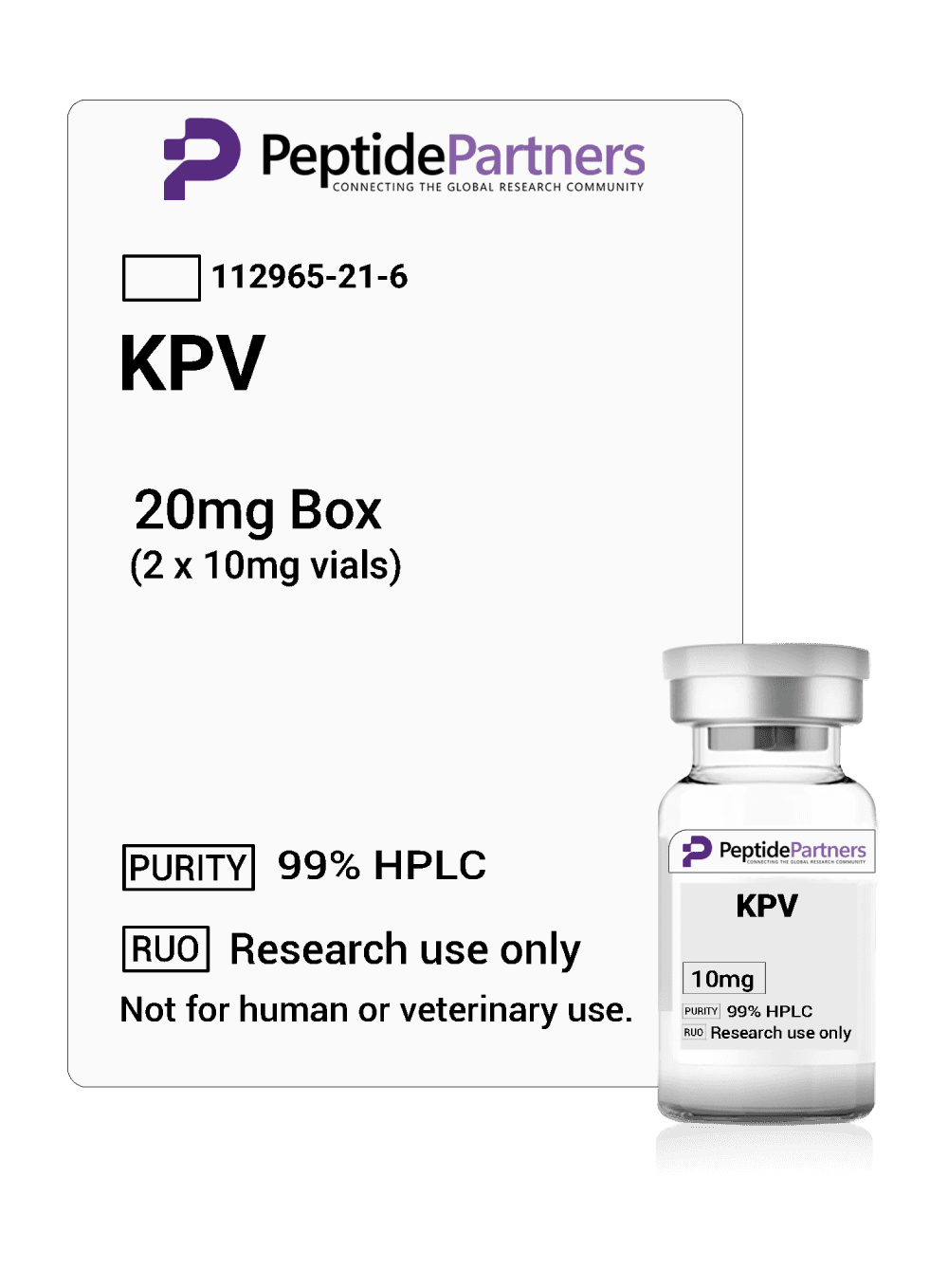
KPV peptide is a chain of three amino acids: lysine, proline, and valine. The name comes from the one-letter codes for those three amino acids: K, P, V. Some pages spell it KVP. That is the same molecule, just letters reordered.
KPV is the C-terminal fragment of alpha-MSH, a 13-amino-acid hormone made in the pituitary gland. The full alpha-MSH molecule has many jobs in the body, including pigmentation, appetite signaling, and immune signaling. KPV keeps the anti-inflammatory part of alpha-MSH but skips the receptor pathway that drives tanning, appetite changes, and the other hormonal effects (Brzoska et al., Endocrine Reviews, 2008).
Because KPV is so small, you may also see it referenced inside longer alpha-MSH sequence searches like CGKPV, GKPV, or KTCGKPV. Those refer to the surrounding amino acids in alpha-MSH, not different drugs. As of May 2026, KPV is not FDA-approved for any human use, and most of what is known about it comes from cell and animal studies.
Mechanism
How KPV works
In plain terms, KPV calms inflammation by blocking the cell's main inflammation switch.
Researchers have mapped the mechanism in two steps. First, KPV is moved into intestinal cells by a transporter called PepT1. Second, once inside, KPV blocks the NF-κB pathway, which is the main driver of inflammatory gene expression. A 2008 Gastroenterology paper showed that nanomolar concentrations of KPV reduced NF-κB and MAP kinase signaling in human gut cell lines and lowered pro-inflammatory cytokine output (Dalmasso et al., Gastroenterology, 2008).
Two details are important. PepT1 is normally only present in the small intestine, but during inflammatory bowel disease it shows up in inflamed colon tissue too, so KPV's transporter is upregulated exactly where inflammation is highest (Viennois et al., Cellular and Molecular Gastroenterology and Hepatology, 2016). And KPV does not act through the melanocortin receptors that drive alpha-MSH's other effects, which is why it does not cause tanning or appetite changes in animal studies.
- PepT1 transporter brings KPV into intestinal cells
- Inside the cell, KPV blocks NF-κB and MAP kinase signaling
- Effects shown in cell lines and mouse colitis models, not human trials
Research use
What the research community uses KPV peptide for
KPV is most often discussed for gut inflammation, skin inflammation, wound healing, and germ-fighting activity. The gut interest comes from mouse colitis studies. Colitis means inflammation in the colon, the lower part of the gut.
KPV is also discussed in stack conversations with BPC-157 because both are tied to gut and inflammation research. That does not mean KPV is approved or proven for people. There is no FDA-approved use and no completed human randomized trial of KPV as a single-ingredient drug.
- Gut inflammation, mostly mouse colitis research.
- Skin inflammation and wound-healing interest.
- Antimicrobial activity, meaning germ-fighting effects in cell studies.
- Stack discussions with BPC-157 for gut and inflammation interest.
Evidence
What the research shows
The strongest single dataset is the 2008 Gastroenterology paper from Dalmasso and colleagues. They gave mice with DSS- and TNBS-induced colitis oral KPV in their drinking water and measured inflammatory markers. The treated animals had less weight loss and lower expression of pro-inflammatory cytokines, and the mechanism was confirmed by silencing PepT1 in cell lines (Dalmasso et al., Gastroenterology, 2008). I checked the original Gastroenterology paper directly to confirm the dose used in the drinking-water arm and the cell-line work were both in the same 2008 study.
A separate German group reported anti-inflammatory effects in three different mouse colitis models, including one in mice with non-functional melanocortin receptors, a finding that supports the idea that KPV does not depend on melanocortin signaling (Kannengiesser et al., Inflammatory Bowel Diseases, 2008). A 2017 Molecular Therapy paper showed that orally targeted KPV nanoparticles reduced colitis severity at doses far below standard oral KPV (Xiao et al., Molecular Therapy, 2017). Wound-healing data comes from a 2006 rabbit corneal model where topical KPV improved epithelial wound closure compared with controls (Bonfiglio et al., Experimental Eye Research, 2006). Antimicrobial data, including activity against MRSA and Candida albicans, comes from in vitro work (Cutuli et al., Journal of Leukocyte Biology, 2000).
The evidence has clear limits. There is no completed human randomized trial of KPV as a single-ingredient drug. The FDA has stated that it 'lacks important information regarding any safety issues raised by KPV, including whether it would cause harm if administered to humans' (FDA, Certain Bulk Drug Substances, 2025). Most data is in mice or in cell culture, and dosing in animal studies does not translate cleanly to humans. The 2008 Brzoska review in Endocrine Reviews, the most-cited synthesis of the alpha-MSH and KPV literature, reached the same conclusion: promising preclinical signal, missing human data (Brzoska et al., Endocrine Reviews, 2008).
Context
How KPV compares to nearby compounds
KPV is most often compared to BPC-157, alpha-MSH, and Melanotan II. They are not interchangeable.
BPC-157 is a 15-amino-acid peptide studied in tendon, ligament, and gut repair models. It is most often discussed as a tissue-repair tool, meaning angiogenesis and collagen-related work, rather than an anti-inflammatory tool. KPV does not promote tissue rebuilding; it acts on the inflammatory pathway. The two are complementary in research-community discussions, but they are different mechanisms.
Alpha-MSH is the parent hormone KPV comes from. It contains KPV at its tail and adds a head section that binds melanocortin receptors. That head section drives pigmentation, appetite, and other hormonal effects. KPV preserves the anti-inflammatory action without those effects in cell and animal models. Melanotan II is a synthetic alpha-MSH analog used for pigmentation; KPV does not cause pigmentation in animal studies because it does not activate the melanocortin receptors involved.
Boundaries
Safety and regulatory status
Reported adverse events in animal models are limited. The FDA's own assessment is more direct: 'FDA has not identified any human exposure data on drug products containing KPV administered via any route of administration' (FDA, Certain Bulk Drug Substances, 2025). That means there is no formal human safety profile.
Theoretical risks discussed in the literature include the standard cautions for any peptide that modulates immune signaling. Pregnancy, active cancer, and active acute infection are commonly listed as contraindications in clinical-practice writing, though that guidance comes from practitioner experience rather than controlled trials.
On the regulatory side, KPV is not FDA-approved as a drug. It was placed on the FDA's 503A Category 2 list (substances raising significant safety concerns) in 2023. As of April 22, 2026, KPV was removed from Category 2 because the nominator withdrew the nomination. That is the FDA's published reason, not a positive safety determination (FDA Federal Register notice, April 16, 2026). The Pharmacy Compounding Advisory Committee is scheduled to discuss KPV-related bulk drug substances (KPV free base and KPV acetate) on July 23, 2026 (FDA, July 23-24, 2026 PCAC meeting notice). The committee's recommendation will inform whether KPV is added to the 503A Bulks List, but that decision has not been made as of this guide's publication on April 30, 2026.
Next
What to review next
If you want to follow the regulatory thread, the FDA's 503A bulk drug substances page and the July 23, 2026 PCAC meeting notice are the primary documents. The April 16, 2026 Federal Register filing names KPV explicitly. For mechanism, the 2008 Dalmasso Gastroenterology paper and the Brzoska Endocrine Reviews paper are the most-cited starting points.
For peptide context, see the related guides on BPC-157 for the most common comparison compound and on Melanotan II for the alpha-MSH-derived compound that does activate melanocortin receptors. Peptide Advisors does not publish dosing protocols or stack instructions for KPV; for protocol-focused research review Peptide Dosing Protocols.
FAQ
KPV FAQs
Short answers for the reusable peptide detail template.
What does KPV do?
KPV is studied as an anti-inflammatory tripeptide. In cell and animal models, it is taken into intestinal cells through the PepT1 transporter and then blocks the NF-κB inflammatory signaling pathway. The strongest single dataset is in mouse colitis, where oral KPV reduced markers of intestinal inflammation. There is no completed human randomized trial of KPV as a single-ingredient drug, so 'what KPV does' in humans is still an open question.
What is KPV peptide?
KPV peptide is a three-amino-acid molecule made of lysine, proline, and valine. It is the C-terminal fragment of alpha-MSH, a 13-amino-acid hormone produced in the pituitary gland. KPV retains the anti-inflammatory action of alpha-MSH but does not activate melanocortin receptors, which is why animal studies show no pigmentation or appetite effects from KPV alone.
Is KPV the same as KVP?
Yes. KPV and KVP refer to the same tripeptide. The letters are simply the one-letter codes for lysine (K), proline (P), and valine (V). 'KVP peptide' is a common typo or reordering of the same name; the molecule is identical.
Is KPV the same as alpha-MSH?
No. KPV is a fragment of alpha-MSH, only its last three amino acids. Alpha-MSH is a full 13-amino-acid hormone with broad effects, including pigmentation, appetite signaling, and immune signaling. KPV preserves the anti-inflammatory part of alpha-MSH and skips the receptor-mediated effects in cell and animal studies.
Does KPV cause tanning like Melanotan II?
Not in published animal and cell research. Melanotan II is a synthetic alpha-MSH analog that activates melanocortin receptors, which drive pigmentation. KPV does not bind those receptors, so studies in mice with non-functional melanocortin receptors still show KPV's anti-inflammatory action and no pigmentation effect. Human data on this question does not exist.
How does KPV compare to BPC-157?
They are studied for different things. KPV is studied as an anti-inflammatory peptide acting through PepT1 and NF-κB. BPC-157 is studied as a tissue-repair peptide tied to angiogenesis and collagen-related processes in animal models. They are not interchangeable. For more, see the BPC-157 guide.
Is KPV FDA-approved?
No. KPV is not FDA-approved for any human use. It was placed on the FDA's 503A Category 2 list in 2023, then removed from Category 2 on April 22, 2026 because the nominator withdrew the nomination. Removal from Category 2 is not approval. The FDA has scheduled a Pharmacy Compounding Advisory Committee meeting on July 23, 2026 to review KPV-related bulk drug substances. As of May 2026, no licensed KPV drug product exists in the United States.
What is the typical KPV peptide dosage?
Peptide Advisors does not publish dosing protocols for KPV. There is no completed human dose-finding trial that would establish an evidence-based dose, and any specific dosing guidance would step outside what the underlying research supports. For protocol-focused research, including how clinical and community sources have discussed KPV dosing, review Peptide Dosing Protocols.
References
/ 11KPV sources & citations
Primary sourcesPrimary clinical literature and pharmacology references behind this guide.
- 01
PepT1-mediated tripeptide KPV uptake reduces intestinal inflammation
Dalmasso G, Charrier-Hisamuddin L, Nguyen HT, et al. · Gastroenterology · 2008
Foundational mechanism paper. KPV reduced NF-κB and MAP kinase signaling in human gut cell lines and lowered colitis severity in DSS- and TNBS-treated mice via PepT1.
- 02
Alpha-melanocyte-stimulating hormone and related tripeptides: biochemistry, antiinflammatory and protective effects in vitro and in vivo, and future perspectives for the treatment of immune-mediated inflammatory diseases
Brzoska T, Luger TA, Maaser C, Abels C, Böhm M. · Endocrine Reviews · 2008
Most-cited synthesis of the alpha-MSH and KPV literature; positions KPV as the anti-inflammatory C-terminal fragment without pigmentary action.
- 03
Critical role of PepT1 in promoting colitis-associated cancer and therapeutic benefits of the anti-inflammatory PepT1-mediated tripeptide KPV in a murine model
Viennois E, Pujada A, Sung J, et al. · Cellular and Molecular Gastroenterology and Hepatology · 2016
Confirmed PepT1 upregulation in inflamed human colon tissue and showed KPV's anti-cancer effect in a colitis-associated cancer model depended on PepT1.
- 04
Melanocortin-derived tripeptide KPV has anti-inflammatory potential in murine models of inflammatory bowel disease
Kannengiesser K, Maaser C, Heidemann J, et al. · Inflammatory Bowel Diseases · 2008
Independent replication of KPV's effect across three mouse colitis models, including in animals with non-functional melanocortin receptors.
- 05
Orally targeted delivery of tripeptide KPV via hyaluronic acid-functionalized nanoparticles efficiently alleviates ulcerative colitis
Xiao B, Xu Z, Viennois E, et al. · Molecular Therapy · 2017
Targeted oral nanoparticle delivery cut effective KPV dose substantially in a mouse colitis model; described KPV as having no notable side effects in that study.
- 06
Effects of the COOH-terminal tripeptide α-MSH 11–13 on corneal epithelial wound healing: Role of nitric oxide
Bonfiglio V, Camillieri G, Avitabile T, et al. · Experimental Eye Research · 2006
Topical KPV applied four times daily improved corneal epithelial wound closure in rabbits compared with controls.
- 07
Antimicrobial effects of alpha-MSH peptides
Cutuli M, Cristiani S, Lipton JM, Catania A. · Journal of Leukocyte Biology · 2000
In vitro antimicrobial activity of KPV and related alpha-MSH peptides against Staphylococcus aureus and Candida albicans.
- 08
Inhibition of cellular and systemic inflammation cues in human bronchial epithelial cells by melanocortin-related peptides: Mechanism of KPV action and a role for MC3R agonists
Land SC. · International Journal of Physiology, Pathophysiology and Pharmacology · 2012
Mechanistic data on KPV's NF-κB suppression in human bronchial epithelial cells; supports a non-melanocortin-receptor pathway.
- 09
Certain bulk drug substances for use in compounding that may present significant safety risks
U.S. Food & Drug Administration · FDA · 2025
FDA's published statement that it lacks human exposure data for drug products containing KPV by any route of administration.
- 10
Bulk drug substances nominated for use in compounding under Section 503A of the Federal Food, Drug, and Cosmetic Act (updated April 22, 2026)
U.S. Food & Drug Administration · FDA · 2026
Lists KPV as removed from Category 2 because the nomination was withdrawn; notes a planned PCAC consultation regarding KPV-related bulk drug substances.
- 11
July 23-24, 2026: Meeting of the Pharmacy Compounding Advisory Committee: Notice of Meeting
U.S. Food & Drug Administration · FDA Federal Register / Advisory Committee Calendar · 2026
FDA notice scheduling PCAC review of KPV (free base) and KPV acetate, alongside BPC-157, TB-500, and MOTs-C, on July 23, 2026.
Medical Disclaimer
This article is provided for educational research purposes only and should not be treated as medical advice. KPV is not FDA-approved. Compounded versions should be used only with appropriate physician oversight. Do not begin any peptide protocol without speaking with a licensed healthcare provider, and remember that individual responses can vary significantly.
Written by

Garret Grant
Founder & Lead Researcher · B.S. Civil Engineering, UCLA
Garret personally researches, writes, and reviews every guide on Peptide Advisors. Each page is sourced from peer-reviewed clinical trials, systematic reviews, and regulatory filings — with every claim cited and the source hierarchy published openly.
Last reviewed