Too Long Didnt Read (TLDR)
Brief summary of the GLOW Stack peptide blend.
The GLOW stack is research-community shorthand for a three-peptide combination of BPC-157, TB-500, and GHK-Cu.
It builds on the simpler Wolverine stack (BPC-157 + TB-500) by adding GHK-Cu, a copper-binding tripeptide studied for collagen and elastin synthesis.
No human randomized trial has tested the three-peptide GLOW combination together. The evidence base is compound-level, not stack-level.
As of April 22, 2026, BPC-157, TB-500, and injectable GHK-Cu were removed from FDA 503A Category 2, with PCAC review of BPC-157 and TB-500 scheduled for July 23, 2026.
I cross-checked the April 15, 2026 FDA announcement against the SSRP Institute notice and the FDA 503A bulk drug substances PDF directly.
Definition
What the GLOW stack is
The GLOW stack is a research-community nickname for combining three peptides in one protocol: BPC-157, TB-500, and GHK-Cu. It is not a single FDA-approved drug, a standardized clinical protocol, or a single branded product. Different suppliers sell pre-blended GLOW vials with their own ratios; the most common ratio you will see online is roughly 50 mg GHK-Cu, 10 mg BPC-157, and 10 mg TB-500 per vial.
GLOW sits between two related stacks. The simpler Wolverine stack uses only BPC-157 and TB-500 and is usually framed around tissue repair. The KLOW stack adds a fourth peptide, KPV, on top of GLOW for an additional anti-inflammatory layer. GLOW differs from Wolverine by adding GHK-Cu, which moves the research focus to include collagen and elastin matrix outcomes alongside repair.
Research use
What the research community uses the GLOW stack for
The GLOW stack is most often discussed for skin quality, collagen, post-procedure recovery, soft-tissue repair, and hair-follicle research. Collagen is a structural protein that helps skin and connective tissue stay firm. The usual idea is that BPC-157 and TB-500 cover repair interest while GHK-Cu adds skin and collagen interest.
The evidence boundary matters. GLOW is not a defined therapy and has not been tested as a three-peptide blend in a controlled human trial. The discussion is based on each compound studied alone, possible pathway overlap, and supplier marketing, not proof that the stack works better than its parts.
- Skin quality and collagen interest.
- Soft-tissue repair, including tendon, ligament, and muscle models.
- Post-procedure skin recovery, such as laser or microneedling contexts.
- Hair-follicle research, mostly tied to GHK-Cu.
Stack logic
Why these three compounds are discussed together
Each component targets a different pathway in the published research. BPC-157 has been studied in animal models for angiogenesis (new blood vessel formation) and soft-tissue repair signaling. TB-500, a synthetic fragment of thymosin β4, has been studied for cell migration and actin-related cytoskeletal dynamics. GHK-Cu, a copper-binding tripeptide, has been studied in topical human trials for collagen, elastin, and skin-density outcomes.
The theoretical logic for combining them is coverage. BPC-157 supports the blood-supply step. TB-500 supports the cell-movement step. GHK-Cu supports the matrix-rebuilding step. This is the rationale you will read in supplier marketing and community write-ups. It is a reasonable description of three distinct mechanisms — but it is a hypothesis about combination effects, not a tested clinical claim.
- BPC-157 → blood-vessel and tissue-repair signaling pathways (animal data)
- TB-500 → cell migration and actin-binding pathways (preclinical and Phase 2 wound-healing data)
- GHK-Cu → collagen and elastin synthesis pathways (multiple human topical trials)
- No published trial has tested the three together as a fixed combination
Evidence
What the research actually shows
There is no direct human evidence for the GLOW stack as a three-peptide combination. The most rigorous way to read the literature is compound by compound, then to be clear that compound-level evidence does not automatically validate the stack.
GHK-Cu has the strongest human evidence in the trio, but almost all of it is topical, not injectable. Multiple controlled trials and reviews report that topical GHK-Cu creams improve collagen production and skin density in postmenopausal women. A widely cited 12-week trial reported collagen increases in 70% of women using a GHK-Cu cream, compared with 50% on a vitamin C cream and 40% on retinoic acid (Pickart and Margolina, IJMS 2018; PMC4508379). I checked the 70/50/40 figure against the IJMS review directly.
TB-500 (synthetic thymosin β4) has progressed further in human trials than BPC-157. A Phase 2 randomized, double-blind, placebo-controlled trial in 72 patients with venous stasis ulcers (NCT00832091) found the topical mid-dose was well tolerated and was associated with earlier initiation of wound healing than placebo. A separate Phase 1 single- and multiple-dose IV trial in 84 healthy Chinese volunteers (Cao et al., 2021; PMC8419156) reported no dose-limiting toxicities or serious adverse events at doses up to 25 µg/kg.
BPC-157 has the thinnest human evidence. Most published data are from rodent models. The largest registered human study (NCT02637284, Phase 1, n=42 planned) did not publish results. A 2025 IV safety pilot in 2 adults (PubMed 40131143) reported no adverse effects up to 20 mg IV, but a sample of two does not establish safety. A 2024 narrative review concluded that human data remain limited and the compound should be considered investigational (PMC12446177).
The honest summary is that GLOW combines one compound with reasonable topical human data (GHK-Cu), one with limited Phase 2 human data (TB-500), and one with very limited human data (BPC-157), and that the three of them have never been studied as a fixed combination in humans.
Context
How GLOW compares to nearby stacks
The closest comparison is the Wolverine stack, which is just BPC-157 and TB-500 without GHK-Cu. Wolverine is usually framed as a repair-focused protocol; GLOW adds GHK-Cu and is usually framed as repair plus collagen and skin quality. The KLOW stack goes one step further by adding KPV, an anti-inflammatory tripeptide, on top of GLOW. None of these are interchangeable, and none of them are defined therapies.
Compared to single-compound research, GLOW is broader but less interpretable. A single compound can be tested in a controlled trial. A three-peptide stack with no fixed ratio cannot, easily, and supplier blends use different ratios. Read GLOW as an umbrella term for a research approach, not as a specific drug.
Boundaries
Safety and regulatory status
Across the three compounds, the most consistently reported observation in published trials is mild, local, transient effects — for example, injection-site reactions for the parenteral compounds and the kind of mild, tolerable adverse events noted in the Phase 1 IV thymosin β4 study. None of this comes from a trial of the GLOW combination itself, so combined safety remains unstudied.
Theoretical risks discussed in the literature include immunogenicity concerns the FDA has cited for compounded peptide bulk substances, and the angiogenesis-promoting properties of BPC-157 and TB-500, which the BodySpec narrative review and other commentators have flagged as a theoretical concern in patients with active malignancy. These are not observed effects in human trials of the GLOW combination, because no such trials exist.
Regulatory status changed materially in April 2026. As of April 22, 2026, the FDA removed BPC-157, TB-500, and injectable GHK-Cu from 503A Category 2, the list of bulk drug substances flagged for significant safety concerns in compounding (FDA 503A bulk substances list, April 22, 2026). The Pharmacy Compounding Advisory Committee is scheduled to review BPC-157 and TB-500 (acetate and free-base forms) on July 23, 2026, with GHK-Cu review anticipated before February 2027. None of these compounds are currently FDA-approved drugs, and the GLOW stack has never been evaluated as a combination product. Topical GHK-Cu is widely used in cosmetics and is treated separately from the injectable compounding pathway.
Next
What to review next
The most useful next step depends on what you are trying to understand. For the strongest single-compound evidence in the stack, read the GHK-Cu peptide guide and the peer-reviewed IJMS review by Pickart and Margolina cited below. For TB-500, the RegeneRx Phase 2 venous stasis ulcer trial and the Cao et al. Phase 1 IV study are the two most informative human references. For BPC-157, the 2024 narrative review (PMC12446177) is the clearest summary of how thin the human evidence base is.
For the related stacks, see the Wolverine stack guide for the simpler two-peptide combination. For research-protocol context (which Peptide Advisors does not publish), see Peptide Dosing Protocols at https://www.peptidedosingprotocols.com/.
Sourcing
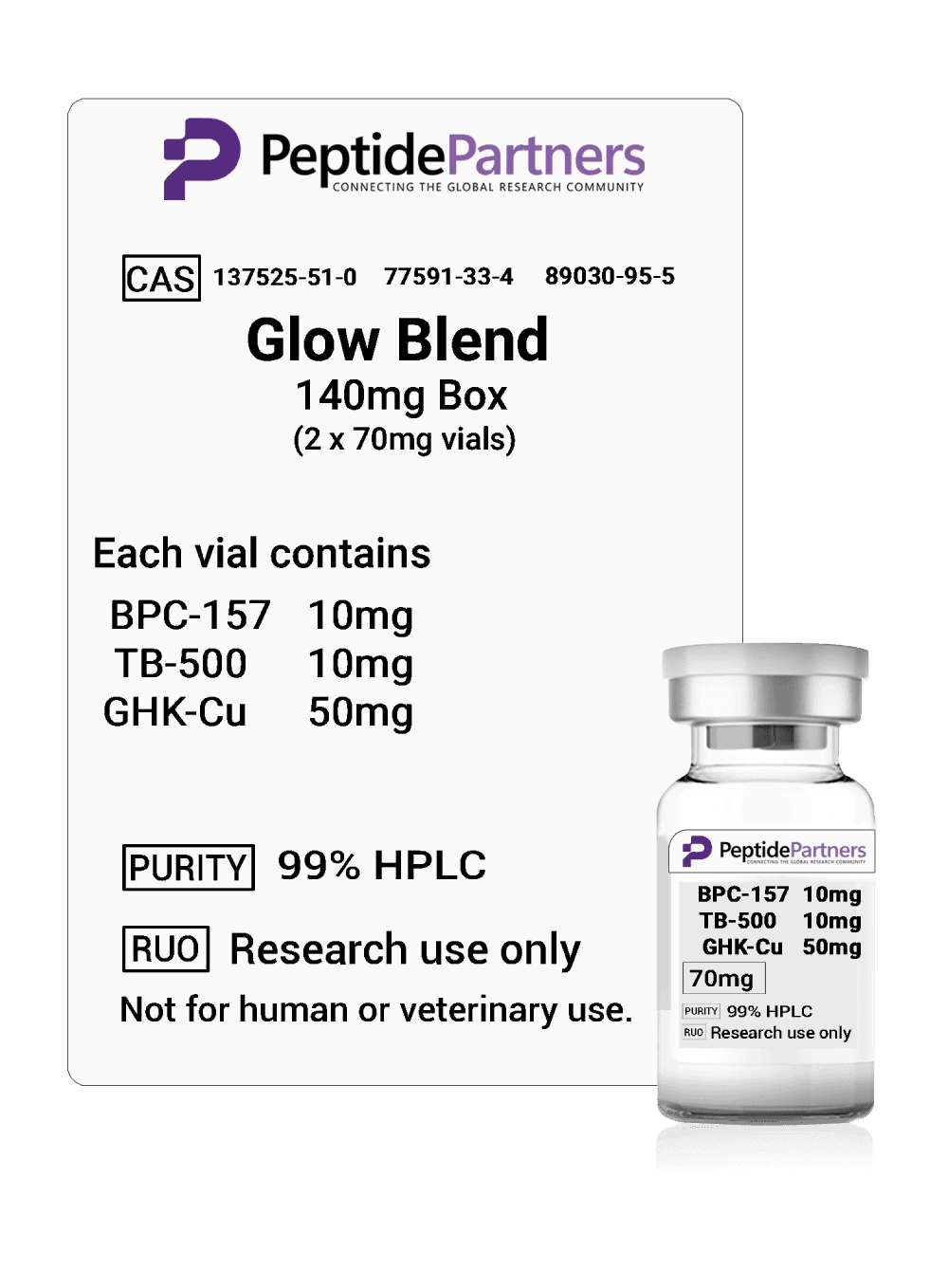
GLOW Stack
View a trusted research-use source for the GLOW peptide stack (BPC-157, TB-500, GHK-Cu).
Buy GLOW StackView COAFAQ
GLOW Stack FAQs
Short answers for the reusable peptide blend detail template.
What is the GLOW peptide stack?
The GLOW stack is a research-community shorthand for combining three peptides — BPC-157, TB-500, and GHK-Cu — in one protocol. It is not an FDA-approved drug or a standardized clinical therapy. Suppliers sell pre-blended GLOW vials, but ratios vary, and the combination has never been tested as a fixed three-peptide product in a human trial.
How is the GLOW stack different from the Wolverine stack?
The Wolverine stack uses two peptides, BPC-157 and TB-500, and is usually framed around tissue repair. GLOW adds a third peptide, GHK-Cu, which has been studied for collagen and elastin synthesis in topical human trials. So GLOW is essentially Wolverine plus a collagen and skin-density layer, at least at the level of research-community framing.
What does GHK-Cu add to the GLOW stack?
GHK-Cu is a copper-binding tripeptide. Multiple controlled topical trials have reported improvements in collagen synthesis and skin density compared with vehicle, vitamin C, or retinoic acid creams. In the GLOW stack, GHK-Cu is the component most associated with skin-quality and matrix-remodeling research. Note that almost all of the human GHK-Cu evidence is topical, not injectable.
Is the GLOW peptide stack FDA-approved?
No. The GLOW stack is not an FDA-approved drug. As of April 22, 2026, BPC-157, TB-500, and injectable GHK-Cu were removed from FDA 503A Category 2, but that does not equal approval. The Pharmacy Compounding Advisory Committee is scheduled to review BPC-157 and TB-500 on July 23, 2026, and GHK-Cu before February 2027.
Is there direct human research on the GLOW combination?
No published human randomized trial has tested the three-peptide GLOW combination together. The evidence base is compound-level: GHK-Cu has the strongest human data (mostly topical), TB-500 has Phase 1 and Phase 2 trials in narrow indications, and BPC-157 has very limited human data. Compound-level evidence does not automatically validate the stack.
What does the research show about each component?
GHK-Cu has multiple controlled topical trials showing increased collagen and skin density. TB-500 (synthetic thymosin β4) has a Phase 2 venous stasis ulcer trial in 72 patients and a Phase 1 IV trial in 84 healthy volunteers, both with favorable safety. BPC-157 has limited human data — a few small pilots and one IV safety study in 2 adults — and most claims about it come from animal models.
What are the dosing protocols for the GLOW stack?
Peptide Advisors does not publish dosing or titration protocols. For protocol-focused research, review Peptide Dosing Protocols at https://www.peptidedosingprotocols.com/. Bear in mind that no clinical trial has tested a fixed GLOW combination, so any protocol you find online is research-community-derived rather than clinically validated.
How does the GLOW stack compare to KLOW?
KLOW adds a fourth peptide — KPV, an anti-inflammatory tripeptide derived from alpha-MSH — on top of the GLOW combination. The framing is that KLOW adds a dedicated anti-inflammatory layer to GLOW's repair-plus-matrix focus. As with GLOW, no human trial has tested KLOW as a fixed combination.
References
/ 10GLOW Stack sources & citations
Primary sourcesPrimary clinical literature and pharmacology references behind this peptide blend guide.
- 01
Regenerative and Protective Actions of the GHK-Cu Peptide in the Light of the New Gene Data
Pickart L, Margolina A. · International Journal of Molecular Sciences · 2018
Comprehensive PMC review summarizing GHK-Cu's effects on collagen, elastin, and gene expression, including the 12-week topical comparison study where 70% of women in the GHK-Cu arm showed collagen increases vs. 50% on vitamin C and 40% on retinoic acid.
- 02
GHK Peptide as a Natural Modulator of Multiple Cellular Pathways in Skin Regeneration
Pickart L, Vasquez-Soltero JM, Margolina A. · BioMed Research International · 2015
Mechanistic review of GHK and GHK-Cu actions on fibroblast function, collagen and proteoglycan synthesis, and wound-healing pathways.
- 03
A Randomized, Double-Blind, Placebo-Controlled, Dose-Response Study of the Safety and Efficacy of Thymosin Beta 4 in the Treatment of Patients With Venous Stasis Ulcers
RegeneRx Biopharmaceuticals (sponsor) · ClinicalTrials.gov registry (NCT00832091) · 2010
Phase 2 RCT, n=72, three topical TB-4 dose levels vs. placebo. Safety and tolerability were the primary outcomes; mid-dose was associated with earlier wound-healing initiation. The strongest available human RCT evidence for TB-500 / TB-4.
- 04
A first-in-human, randomized, double-blind, single- and multiple-dose, phase I study of recombinant human thymosin β4 in healthy Chinese volunteers
Cao Y, Liu Y, Li R, Yang Y, Yang L, Cao H, Yang Y, Zhang Y, Wang H. · British Journal of Clinical Pharmacology / PMC · 2021
Phase 1 SAD/MAD trial of intravenous recombinant human thymosin β4 in 84 healthy volunteers (54 SAD + 30 MAD). No dose-limiting toxicities or serious adverse events at doses up to 25 µg/kg.
- 05
Safety of Intravenous Infusion of BPC157 in Humans: A Pilot Study
Chang AC. · PubMed (PMID 40131143) · 2025
Two-patient pilot of IV BPC-157 up to 20 mg with no observed adverse effects. Useful as a data point but a sample of two cannot establish safety.
- 06
Phase I, Pilot Study in Healthy Volunteers, to Assess the Safety and Pharmacokinetics of PCO-02 (BPC-157)
PharmaCotherapia d.o.o. (sponsor) · ClinicalTrials.gov registry (NCT02637284) · 2015
Registered Phase 1 oral BPC-157 trial in 42 planned healthy volunteers. Status remains 'Unknown' on ClinicalTrials.gov and no peer-reviewed results have been published, illustrating the human-evidence gap for BPC-157.
- 07
Regeneration or Risk? A Narrative Review of BPC-157 for Musculoskeletal Healing
(Authors per PMC record) · PMC narrative review (PMC12446177) · 2024
Narrative review concluding that despite robust preclinical data, human trial data on BPC-157 are limited and the compound should be considered investigational pending well-designed RCTs.
- 08
BPC-157: A prohibited peptide and an unapproved drug found in health and wellness products
Operation Supplement Safety (U.S. Department of Defense) · OPSS / DoD educational article · 2025
Regulatory and anti-doping summary used to confirm WADA prohibited-list status (S0) and FDA unapproved-drug classification through 2025.
- 09
Interim Policy on Compounding Using Bulk Drug Substances Under Section 503A — 503A bulk substances list update
U.S. Food and Drug Administration · FDA.gov 503A bulk drug substances PDF (updated April 22, 2026) · 2026
Primary regulatory source confirming the April 2026 removal of BPC-157, TB-500, MOTs-C, KPV, Semax, Epitalon, DSIP, LL-37, DiHexa, PEG-MGF, Melanotan II, and injectable GHK-Cu from Category 2, and the planned PCAC reviews on July 23, 2026 and before February 2027.
- 10
FDA Announces Change in Status of 12 Peptides
Scientific & Standards-based Research Practices (SSRP) Institute · SSRP Institute regulatory news · 2026
April 15, 2026 announcement summarizing the FDA Category 2 removals — used as a secondary corroboration of the FDA primary source.
Medical Disclaimer
This article is provided for educational research purposes only and should not be treated as medical advice. GLOW Stack is not an FDA-approved protocol or recommendation. Peptide blends should be evaluated only with appropriate physician oversight. Do not begin any peptide protocol without speaking with a licensed healthcare provider, and remember that individual responses can vary significantly.
Written by

Garret Grant
Founder & Lead Researcher · B.S. Civil Engineering, UCLA
Garret personally researches, writes, and reviews every guide on Peptide Advisors. Each page is sourced from peer-reviewed clinical trials, systematic reviews, and regulatory filings — with every claim cited and the source hierarchy published openly.
Last reviewed