Too Long Didnt Read (TLDR)
Brief summary of the KLOW Peptide peptide blend.
KLOW is a research-community blend of four peptides: GHK-Cu, BPC-157, TB-500, and KPV.
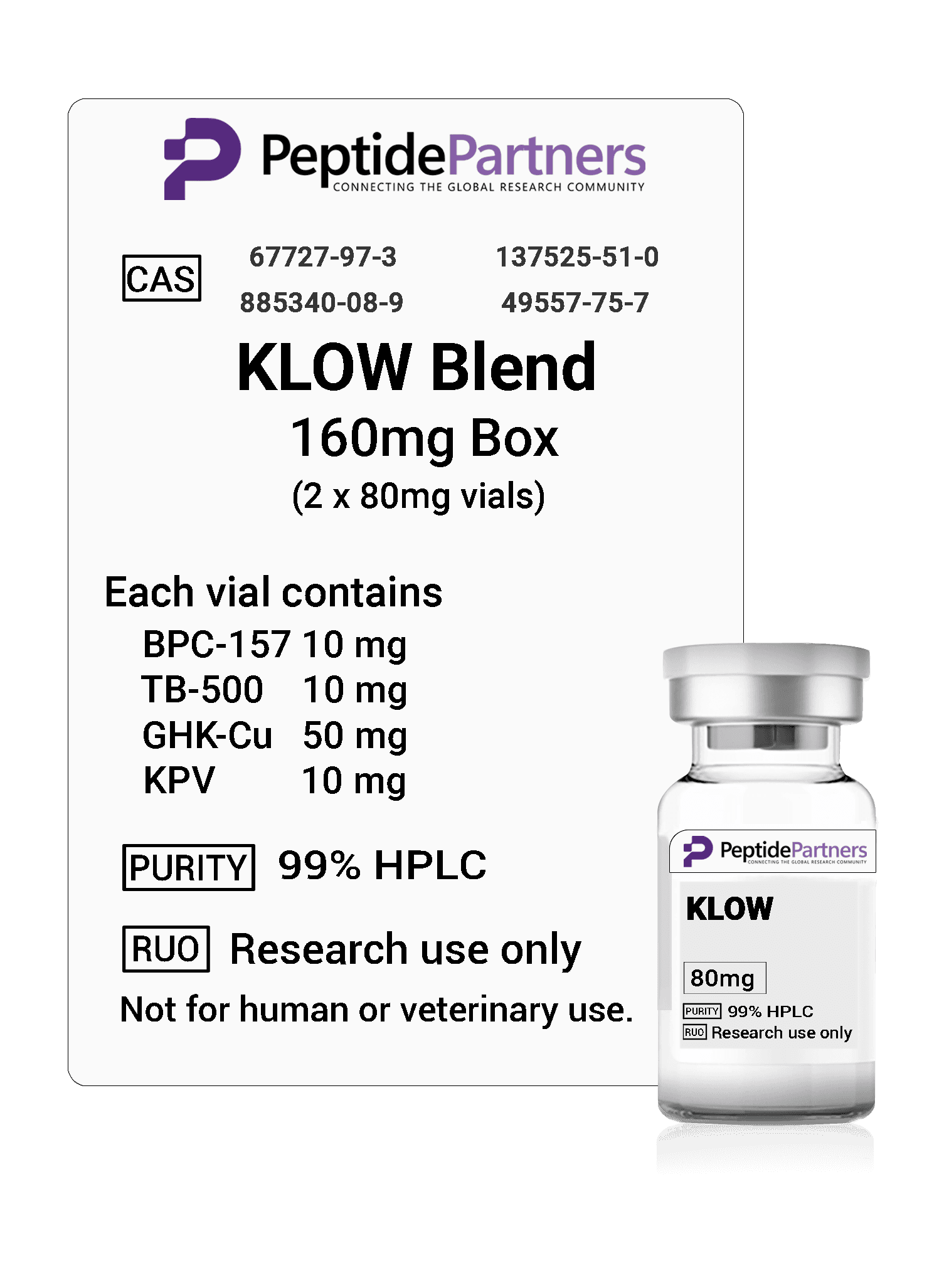
It is typically sold as an 80 mg pre-mixed vial in a 50/10/10/10 mg ratio.
Each compound is studied in a different repair pathway: GHK-Cu for collagen and tissue remodeling, BPC-157 for soft-tissue and gut repair, TB-500 for cell migration and wound closure, and KPV for inflammation control.
There is no published human trial of the four-peptide combination.
I checked this against the April 15, 2026 FDA Federal Register notice scheduling the July 23, 2026 PCAC meeting. Three of the four compounds are now under formal compounding review, while injectable GHK-Cu is scheduled separately. The blend is not FDA-approved and should not be treated as a medical protocol.
Definition
What KLOW is
KLOW is an informal research-community name for a four-peptide blend made of GHK-Cu, BPC-157, TB-500, and KPV. The name is not an FDA-approved drug name and not a medical protocol. It is a shorthand researchers and suppliers use for one combined vial.
The most common version is an 80 mg vial sold as 50 mg GHK-Cu plus 10 mg each of BPC-157, TB-500, and KPV. Some suppliers vary the ratio. The product is sold as a research compound, not a medicine.
The four peptides were placed in FDA 503A Category 2 in 2023, which limited compounding-pharmacy access. On April 15, 2026 the FDA published a Federal Register notice removing BPC-157, TB-500, KPV, and several others from Category 2 and scheduled a Pharmacy Compounding Advisory Committee meeting for July 23, 2026 to review them for the 503A Bulks List. Injectable GHK-Cu was scheduled for separate review by February 2027.
- Research-community blend, not a standardized clinical protocol.
- Typical 80 mg vial: 50 mg GHK-Cu + 10 mg BPC-157 + 10 mg TB-500 + 10 mg KPV.
- Status as of May 2026: not FDA-approved, three of four compounds under formal PCAC review.
Research use
What the research community uses KLOW for
KLOW is most often discussed for broad recovery, soft-tissue repair, gut-barrier support, skin quality, and inflammation research. Gut barrier means the lining that helps keep the contents of the gut separated from the rest of the body. The four peptides are grouped because each one is tied to a different repair or inflammation pathway.
That does not mean the four-peptide blend has been proven in people. Some parts have human data, and some parts are still mostly animal or cell research. The practical topics are soft tissue, tendons, gut inflammation, skin and collagen, and broad recovery interest.
- Soft-tissue and tendon repair interest.
- Gut-barrier and gut-inflammation research.
- Skin quality and collagen research.
- Inflammation control, mostly from KPV and GHK-Cu evidence.
- No published human trial has tested the full four-peptide blend.
Stack logic
Why these four compounds are discussed together
The theoretical rationale rests on layered, non-overlapping mechanisms. GHK-Cu carries copper into cells and is studied for collagen and elastin production, antioxidant signaling, and broad gene-expression changes. Pickart and Margolina's 2018 review describes effects across thousands of genes in cell-line work. BPC-157 is studied in animal models for angiogenesis through eNOS and nitric-oxide pathways, fibroblast activity, and gut-mucosa protection. TB-500 binds G-actin, which is the part of the cytoskeleton that lets cells crawl. That single interaction underpins cell migration, stem-cell mobilization, and corneal wound closure in published studies.
KPV is the C-terminal three amino acids of alpha-MSH and acts mainly through PepT1 and NF-κB inhibition rather than melanocortin receptors, based on work by Dalmasso and colleagues. The combination logic is that you have one peptide for matrix and gene-level remodeling, two for the angiogenesis-and-migration phase of repair, and one for the inflammatory background. That logic is mechanistic extrapolation, not human-trial evidence. The combination has not been tested as a unit in any registered clinical study I could locate on ClinicalTrials.gov.
- GHK-Cu: collagen and gene-expression layer.
- BPC-157: angiogenesis and tissue-protection layer.
- TB-500: cell-migration and wound-closure layer.
- KPV: inflammation-modulation layer.
- The combination is theoretical layering, not validated synergy in humans.
Evidence
What the research actually shows
Direct stack evidence is absent. There is no peer-reviewed human trial of GHK-Cu plus BPC-157 plus TB-500 plus KPV as a combined product. Every claim about KLOW comes from extrapolating individual-compound data, and that gap should be the first thing readers understand.
At the compound level, TB-500 (thymosin beta-4) has the strongest human signal. Two Phase 2 trials in stasis and pressure ulcers reported faster healing in patients who responded, summarized by Goldstein, Hannappel, Sosne, and Kleinman in Expert Opinion on Biological Therapy (2012). BPC-157 has only three small human pilot studies: intra-articular knee pain, interstitial cystitis, and an intravenous safety study, described in a 2025 narrative review by McGuire and colleagues. Animal data is broader but does not substitute for human evidence. GHK-Cu has decades of in vitro and topical-cosmetic research from Pickart's lab; injectable human data is limited. KPV has been studied almost entirely in rodent colitis models (Kannengiesser et al. 2008, Dalmasso et al. 2008).
The honest summary is that KLOW combines one peptide with Phase 2 dermal-wound trials, one with three small human pilots, one with extensive cosmetic and cell-line evidence, and one with rodent-model evidence only. None of those records justify treating the four-peptide combination as a proven clinical intervention.
Context
How KLOW compares to nearby blends and single peptides
The closest comparison is the Wolverine blend, which is BPC-157 plus TB-500. Wolverine is narrower because it focuses on the soft-tissue and angiogenesis layers without the GHK-Cu remodeling layer or the KPV inflammation layer. KLOW is the broader, four-peptide version of the same concept. A second nearby comparison is the GLOW blend, which usually pairs GHK-Cu with BPC-157 and TB-500 (no KPV). The peptides are not interchangeable, and a blend is not automatically better than a single compound. It is a different research model, with the added complication that more peptides means more possible variables and more possible contamination risk in unregulated supply.
Boundaries
Safety and regulatory status
Observed safety data on the four-peptide combination does not exist in the published literature. Compound-level safety records are uneven. BPC-157 has a 2020 preclinical safety evaluation by Xu and colleagues that found it well-tolerated in animal models and a small intravenous human pilot that reported no adverse effects, but the 2025 narrative review by McGuire et al. concludes large-scale human safety data is still missing. TB-500 has Phase 2 dermal trial safety data but limited long-term human follow-up. GHK-Cu has a long topical safety record; injectable safety data is much thinner. KPV has not been formally evaluated for human safety in published RCTs.
Theoretical risks separate from observed risks include contamination from unregulated suppliers, immunogenic responses to peptide impurities, and unknown interactions when four peptides are combined in one vial. These risks are not specific to KLOW. They apply broadly to grey-market peptide use.
Regulatory status as of May 2026: BPC-157, TB-500, and KPV were removed from FDA 503A Category 2 effective April 22, 2026, and scheduled for PCAC consultation on July 23, 2026, per the Federal Register notice published April 16, 2026. Injectable GHK-Cu is scheduled for separate PCAC review by February 2027. Removal from Category 2 is not approval. It means the formal review process has been scheduled. None of the four compounds is currently FDA-approved for any human use. This is not medical advice.
Next
What to review next
Read the individual compound guides for the underlying evidence on each peptide: the GHK-Cu guide for the Pickart gene-expression literature, the BPC-157 guide for the human pilot studies and animal-model record, the TB-500 guide for the Phase 2 dermal-wound trials, and the KPV guide for the rodent colitis work. The four-peptide combination is a layered model, and reviewing the individual records is the only honest way to evaluate whether the layering claim is supported.
For protocol-focused research, including dosing schedules, reconstitution math, and cycle structure, Peptide Advisors does not publish protocols. Review Peptide Dosing Protocols for that side of the literature.
Watch the FDA Pharmacy Compounding Advisory Committee outcome from the July 23, 2026 meeting. That outcome will materially change what is legally compoundable for BPC-157, TB-500, and KPV. The injectable GHK-Cu PCAC review is on a separate track scheduled by February 2027.
Sourcing
KLOW Peptide Blend
View a trusted research-use source for the KLOW peptide blend (GHK-Cu, BPC-157, TB-500, KPV).
Buy KLOW stackView COAFAQ
KLOW Peptide FAQs
Short answers for the reusable peptide blend detail template.
What is in the KLOW peptide blend?
KLOW is a four-peptide research blend most commonly sold as an 80 mg vial containing 50 mg GHK-Cu, 10 mg BPC-157, 10 mg TB-500, and 10 mg KPV. Some suppliers offer different ratios, so the exact amounts depend on the specific product. KLOW is not an FDA-approved drug. It is a research-use blend.
Is the KLOW peptide blend FDA-approved?
No. KLOW is not approved by the FDA as a combination, and none of the four individual compounds is currently FDA-approved for human use either. As of April 22, 2026 the FDA removed BPC-157, TB-500, and KPV from 503A Category 2 and scheduled them for Pharmacy Compounding Advisory Committee review on July 23, 2026. Injectable GHK-Cu is on a separate track for review by February 2027.
Is there direct human research on KLOW as a four-peptide combination?
No published human clinical trial has tested GHK-Cu, BPC-157, TB-500, and KPV together as a combined blend. All claims about KLOW are extrapolated from individual-compound studies. That gap is the most important thing to understand before treating KLOW as anything more than a research model.
Why are these four peptides discussed together?
Each peptide acts on a different part of the repair sequence in preclinical models. GHK-Cu is studied for collagen synthesis and gene-expression effects. BPC-157 is studied for angiogenesis and gut-mucosa protection in animal models. TB-500 binds actin and is studied for cell migration and wound closure. KPV is the C-terminal of alpha-MSH and is studied for anti-inflammatory effects. The combination logic is mechanistic layering, not validated human synergy.
How is KLOW different from the Wolverine stack?
Wolverine is BPC-157 plus TB-500, two peptides focused on soft-tissue and angiogenesis research. KLOW adds GHK-Cu for collagen and remodeling research and KPV for inflammation research. KLOW is broader; Wolverine is narrower. Neither has direct human stack-level trial evidence, and they should not be treated as interchangeable.
What is the strongest published evidence behind any KLOW compound?
TB-500 (thymosin beta-4) has the strongest human signal. Two Phase 2 trials in stasis and pressure ulcers reported faster wound closure in responding patients, summarized by Goldstein, Hannappel, Sosne, and Kleinman in Expert Opinion on Biological Therapy in 2012. The other three compounds have weaker human records, with BPC-157 having only three small human pilot studies and KPV having only rodent-model data.
What dose of KLOW peptide should be used?
Peptide Advisors does not publish dosing protocols. The KLOW combination has not been tested in any registered human trial, so there is no clinical dose to cite. For protocol-focused research, including reconstitution math and compound-level schedules, review Peptide Dosing Protocols. Do not treat any of this as medical advice.
What changed with KLOW compounds and FDA Category 2 in April 2026?
On April 15, 2026 the FDA published a Federal Register notice removing BPC-157, TB-500, KPV, and others from 503A Category 2 effective April 22, 2026, and scheduled a Pharmacy Compounding Advisory Committee meeting on July 23, 2026 to formally review them for the 503A Bulks List. Injectable GHK-Cu is scheduled for separate review by February 2027. Removal from Category 2 is not the same as approval. It means the formal review path has been scheduled.
References
/ 11KLOW Peptide sources & citations
Primary sourcesPrimary clinical literature and pharmacology references behind this peptide blend guide.
- 01
Regeneration or Risk? A Narrative Review of BPC-157 for Musculoskeletal Healing
McGuire F, Martinez R, Lenz A, Skinner L, Cushman D · Current Reviews in Musculoskeletal Medicine (PMC) · 2025
Scoping review of 36 BPC-157 studies (35 preclinical, 1 clinical) concluding human evidence is extremely limited and BPC-157 should be considered investigational.
- 02
Multifunctionality and Possible Medical Application of the BPC 157 Peptide: Literature and Patent Review
Drasar PB, Khripach VA, et al. · International Journal of Molecular Sciences (PMC) · 2025
Comprehensive review of BPC-157 mechanisms and safety profile, noting the WADA temporary ban in 2022 and the absence of FDA approval.
- 03
Safety of Intravenous Infusion of BPC157 in Humans: A Pilot Study
Authors per PubMed listing · PubMed (PMID 40131143) · 2024
Pilot study of intravenous BPC-157 up to 20 mg in 2 healthy adults reporting no adverse effects. Small but one of only three published human safety reports.
- 04
Thymosin β4: A Multi-Functional Regenerative Peptide. Basic Properties and Clinical Applications
Goldstein AL, Hannappel E, Sosne G, Kleinman HK · Expert Opinion on Biological Therapy · 2012
Foundational review describing thymosin beta-4 mechanism (actin binding, cell migration, anti-apoptotic, anti-inflammatory) and the basis for ongoing dermal and corneal trials.
- 05
The Regenerative Peptide Thymosin β4 Accelerates the Rate of Dermal Healing in Preclinical Animal Models and in Patients
Authors per PubMed listing · Annals of the New York Academy of Sciences · 2012
Report of two Phase 2 clinical trials in stasis and pressure ulcers showing accelerated healing in responding patients. This is the strongest human signal across the four KLOW compounds.
- 06
GHK Peptide as a Natural Modulator of Multiple Cellular Pathways in Skin Regeneration
Pickart L, Margolina A · BioMed Research International (PMC) · 2015
Pickart-lab review describing GHK-Cu effects on collagen, gene expression, and tissue regeneration. This is the core mechanistic citation for the GHK-Cu compound.
- 07
Regenerative and Protective Actions of the GHK-Cu Peptide in the Light of the New Gene Data
Pickart L, Margolina A · International Journal of Molecular Sciences (PMC) · 2018
Updated review of GHK-Cu gene-expression effects across thousands of human genes, including the Connectivity Map analysis frequently cited in KLOW marketing.
- 08
Melanocortin-Derived Tripeptide KPV Has Anti-Inflammatory Potential in Murine Models of Inflammatory Bowel Disease
Kannengiesser K, Maaser C, Heidemann J, et al. · Inflammatory Bowel Diseases (Oxford) · 2008
Foundational rodent-model paper showing KPV reduces colitis severity, MPO activity, and inflammatory infiltrates in DSS- and transfer-colitis models.
- 09
PepT1-Mediated Tripeptide KPV Uptake Reduces Intestinal Inflammation
Dalmasso G, Charrier-Hisamuddin L, et al. · Gastroenterology (PMC) · 2008
Established the PepT1 transporter mechanism for KPV anti-inflammatory activity and its role in NF-κB inhibition rather than melanocortin-receptor signaling.
- 10
July 23–24, 2026: Meeting of the Pharmacy Compounding Advisory Committee
U.S. Food and Drug Administration · FDA Advisory Committee Calendar · 2026
Official FDA notice scheduling PCAC consultation on BPC-157, TB-500, KPV, and MOTs-C bulk drug substances for inclusion on the 503A Bulks List.
- 11
Bulk Drug Substances Nominated for Use in Compounding (April 2026 update)
U.S. Food and Drug Administration · FDA media library · 2026
FDA bulks-list document showing BPC-157, TB-500, KPV, and MOTs-C scheduled for July 23, 2026 PCAC review and GHK-Cu (injectable) scheduled by February 2027.
Medical Disclaimer
This article is provided for educational research purposes only and should not be treated as medical advice. KLOW Peptide is not an FDA-approved protocol or recommendation. Peptide blends should be evaluated only with appropriate physician oversight. Do not begin any peptide protocol without speaking with a licensed healthcare provider, and remember that individual responses can vary significantly.
Written by

Garret Grant
Founder & Lead Researcher · B.S. Civil Engineering, UCLA
Garret personally researches, writes, and reviews every guide on Peptide Advisors. Each page is sourced from peer-reviewed clinical trials, systematic reviews, and regulatory filings — with every claim cited and the source hierarchy published openly.
Last reviewed