Peptide blendMay 20262 min
Wolverine stack guide
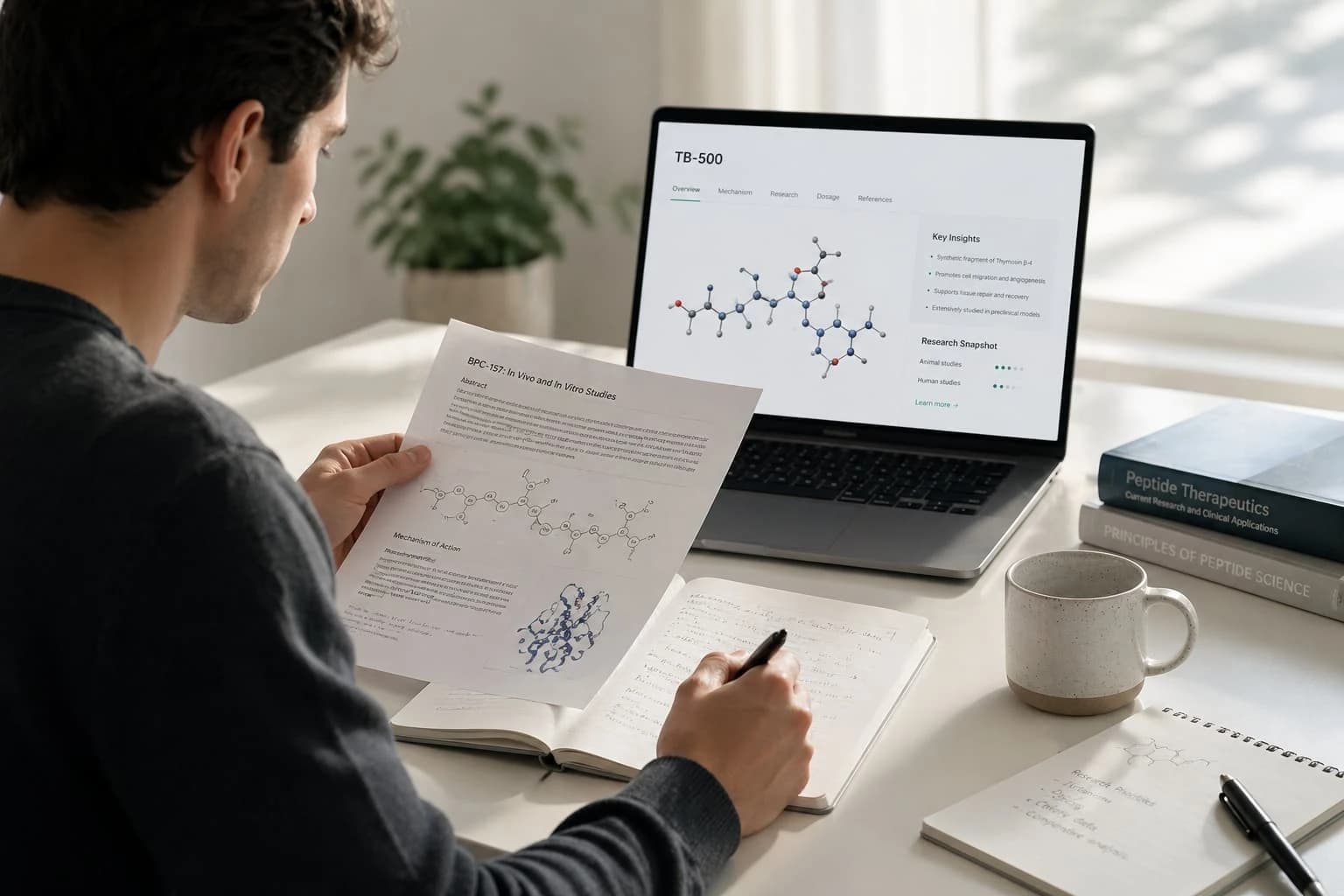
A lean peptide blend preview covering the common BPC-157 and TB-500 recovery-stack shorthand and the research boundary.
Independent Peptide Research
Plain-language guides, mechanism breakdowns, and clinical evidence summaries for the most-researched peptides — written so you can compare compounds, evaluate the science, and decide what's worth a closer look.
The Library
/ 07 entriesConcise, sourced overviews of the peptides researchers and clinicians ask about most. Every entry covers what the compound is, how it works, what the clinical evidence shows, and how it compares to similar peptides — in plain language, with every claim cited.
Triple agonist
GLP-1, GIP, and glucagon receptor agonist under investigation for metabolic and weight-related outcomes.
Read overviewMitochondrial-derived peptide
Mitochondrial-derived peptide studied in metabolism, exercise capacity, aging, and AMPK-related cellular energy signaling.
Read overviewLongevity peptide
Synthetic tetrapeptide studied for telomere activity, circadian aging, sleep rhythm questions, and longevity research limits.
Read overviewTissue repair peptide
Synthetic thymosin beta-4 fragment studied for tissue repair, wound healing, and regulatory-status questions.
Read overviewPentadecapeptide
Synthetic 15-amino-acid peptide researched in tissue repair and gastrointestinal models. No FDA-approved formulation.
Read overviewGHRH analog
FDA-approved GHRH analog studied for HIV-associated lipodystrophy, visceral fat, and growth-hormone signaling.
Read overviewCopper tripeptide
Copper-binding tripeptide explored in skin signaling, wound healing, and hair follicle research.
Read overviewOur Approach
/ 03 principlesMost peptide information online is either supplier marketing or anonymous forum debate. Peptide Advisors was built to be the alternative: structured, sourced, plain-language education that helps readers understand a compound before they decide whether it's relevant to their research.
Every guide is grounded in peer-reviewed clinical trials, systematic reviews, and regulatory filings. Every claim is cited. The source hierarchy is published openly so any reader can verify the evidence.
No supplement sales. No paid placements. No supplier-funded content. Affiliate links, where they appear, are clearly disclosed and never influence how a compound or its evidence is presented.
Each guide follows the same standardized format — definition, mechanism, evidence, comparison, regulatory status — so concepts build on one another and similar compounds can be compared on equal terms.
Recent Writing
/ 02 entriesA lean peptide blend preview covering the common BPC-157 and TB-500 recovery-stack shorthand and the research boundary.
A research-first look at the BPC-157, TB-500, and GHK-Cu stack shorthand, including where the compound-level evidence stops.
Beyond the Guides
Once you understand what petptides are and how they work, dosing-specific references and reconstitution tools live on adjacent independent sites. Peptide Advisors is the foundation — the explainer layer. The links below are where readers go next.